The intention is positive, but the outcome has the potential to be problematic.
I’m talking about the concept of “finding your why”.
Now, don’t get me wrong. I believe it is good to start to think about this. Our “why” is important. It helps us find meaning and prioritize. It allows us to filter the information we receive and create our perception of the world around us. Two people can look at the same picture, the same tree, the same sky and feel completely different things. This is because of the different “why” they each have in their life.
Our why can be the lens in which we view the world. It can impact what we see, our feelings and our actions.
We ask ourselves: Why am I doing this? It seems simple enough.
And, this is where I believe we really need to come back to: simplicity.
I talk to many people who overthink this task to “find their why”. They have been influenced by the people they follow on social media, they feel guilty for not having a “good enough” why, an altruistic why and some are even intimidated.
Shouldn’t my “why” be grand and big and lofty? Shouldn’t it be “because I want to change the world”?
Maybe. If that motivates you. If that drives you.
But grand, big and lofty actions don’t always need to come from such a huge WHY. In fact, often the most personal, seemingly small motivations can have the biggest impact and enable us to push us forward and meet our dreams.
Examples of Why
What are some other examples of simple, personal but meaningful whys? Here’s a few to think about:
– Because I want to enjoy my life
– Because I don’t know if I’ll like it, but I want to give it a try
– Because I am curious
Maria, you may be thinking. Some of these seem a bit… selfish. They are about me. They aren’t about me saving the world. Can your why really be something as simple as “Because I want to enjoy my life”?
Yes, yes, yes. 1,000 times yes. This is allowed. This is encouraged!
And…why? (joke intended!)
Because. When you are happy and joyful, you show up as your authentic self and are able to bring your unique gifts to the world.
How to Find Your (Simple) Why
Now that we understand that a personal and simple why can be beneficial and important, how do we each find that which is most meaningful for us?
Begin with your personal why by honestly answering some of these questions:
– What do I live for? For whom?
– Why do I live?
– Why do I really want to live?
– What drives me?
– What do I really enjoy doing?
– What do I want to try more of?
It is OK to start on a larger scale and then hone in on specific areas of your life. Your “why” will likely be different for different areas of work, projects, hobbies, relationships or other experiences. And, your “why” may change over time.
Be open to giving yourself the gift of curiosity as you explore your simple why. You’ll inspire others simply by exploring and living out loud.
After all, sometimes the reason for your “why” can be as simple as “why not?”
https://mariawade.us/wp-content/uploads/2021/10/executive-leadership-coaching-USA-maria-wade-1041.jpg10801920MARIA WADEhttps://mariawade.us/wp-content/uploads/2026/03/10-maria-wade-l-1.pngMARIA WADE2021-10-27 15:05:002025-06-23 15:13:01Motivation: Is it Possible to Overthink Your “Why”?
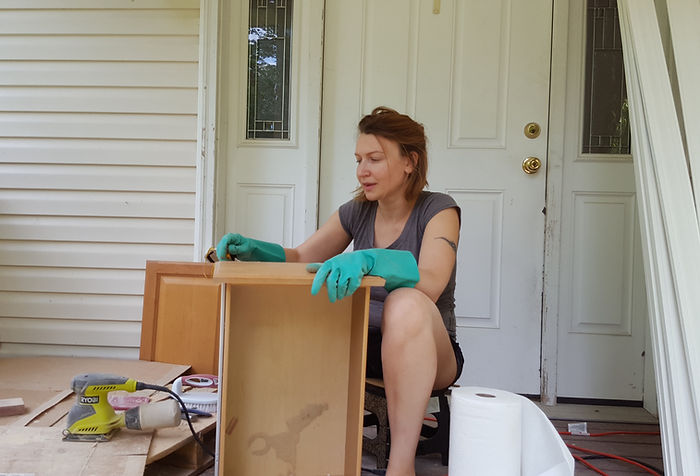
I found a photograph the other day. In this photograph, I am sitting on the porch of our first house here in America. I am removing the paint from kitchen cabinets. I remember that it took hours. I was so proud of myself once this project was complete. I repainted each cabinet; I made them beautiful.
I don’t know if I’ll ever need to use this skill again. I’m not sure if I’ll ever need to remove paint from cabinets or do any type of kitchen refurbishment. Looking at this photo again got me thinking: Does that mean this was a wasted skill to learn?
I remember hearing this sentiment a lot as a child and maybe you heard some version of it, too: “When you leave school, just forget about what you learned, because you will never need it again.”
This stuck with me.
And, the comments continued.
“When you come to work, forget everything you learned at university because you won’t use it.”
What is the message here? You are investing a lot of time in learning, but you won’t need this in your life.
Do I agree? Do I feel that skills obtained that go unused have been a waste of time? Something worth forgetting?
It might not surprise you to hear that I say “no”… My take is that there is no wasted learning or wasted skills because you never know what you can use in the next moment.
Sometimes it will be a direct connection and sometimes it will be indirect.
For example, I learned how to milk a goat. Yes, it is true. And, where can I use this skill again? I don’t plan on spending too much time around livestock any time soon…
But here’s how I think about it (and this is where the “indirect” connection comes in): It’s not exactly what I learned. It is often the mindset, perspective, experience, or secondary skills gained that are what sticks with us the most. Often, a lesson learned may even be (unknown) preparation for something awaiting you in your future.
When it comes to that cabinet work? This showed me that I can do physical labor and I enjoy doing this. It really calms me down and has helped me see that whatever happens in my life, I can deal with it. I can take on challenges and overcome the unknown.
Another example: baking. How to make a perfect cake is not the only thing I have learned from baking. I also honed my ability to appropriately allocate my time and attention, to complete several tasks simultaneously and to pay attention to many items in my head while keeping the big picture in mind. Said another way: I applied my project management skills to a new hobby.
Ultimately, we don’t know what, when and how we will use the many skills and experiences we pick up, but I dare say there’s no such thing as a useless skill.
And if you happen to hear of anyone needing their goat milked… you know where to find me.
All the photos are provided by Maria Wade.
https://mariawade.us/wp-content/uploads/2021/10/executive-leadership-coaching-USA-maria-wade-1040.jpg10801920MARIA WADEhttps://mariawade.us/wp-content/uploads/2026/03/10-maria-wade-l-1.pngMARIA WADE2021-10-20 15:03:002025-06-23 15:13:23Lessons Learned: No Such Thing as “Useless” Skills
After I published my post on the Perfect Day exercise, a colleague reached out with something that stuck with me. She shared my resistance to the “where do you see yourself in five to ten years” question, but she named a specific version of the trap I hadn’t fully articulated: the way we default to planning our futures in terms of roles.
I want to be a director. I want to run my own firm. I want to make partner.
These sound like ambitions. They feel concrete. But they are actually some of the most limiting ways to think about what comes next, because they lock your imagination into a structure someone else designed. A title tells you almost nothing about how you’ll spend your Tuesday afternoon. And yet, when most people plan their futures, that’s where they start.
I know this because I lived it.
The credentials that didn’t open the doors I expected
When I moved to the United States, I arrived with years of leadership experience, including C-level positions, and a career I had built in my home country. I had real ground under my ambitions. I did what seemed logical: I set about verifying every credential I could. I passed my PMP certification again. I earned a Change Management certification. I updated my résumé and started applying for the roles that matched my background.
The rejections came steadily. Not one or two, but enough to make me question whether everything I had built before was transferable at all. I was making decisions based on roles I had held, qualifications I could prove on paper, and what seemed like a rational next step. I was asking the labor market to confirm an identity I had carried with me across an ocean. It kept saying no.
At the time, this felt like failure. I was qualified. I had done the work. The logic was sound. Why wasn’t it working?
Looking back, I can see what I couldn’t then: I was trying to fit myself into a shape that had already served its purpose. The roles I was chasing belonged to a version of my career that was complete. But I didn’t have language for that yet, so I kept applying for variations of what I already knew.
What the exercise showed me that my résumé couldn’t
Somewhere in the middle of all those rejections, I did the Perfect Day exercise.
I didn’t write about a title. I didn’t describe an office or a reporting structure. What came out, when I let myself write freely, was this: I saw myself working with people. Having real conversations. Sharing ideas. Asking questions that mattered.
That was it. No company name, no industry, no level. Just the texture of a day that felt like mine.
I shared this with a friend. Her response was immediate: “What about coaching?”
It was one of those moments where someone sees something in your own writing that you haven’t seen yourself. The Perfect Day exercise had bypassed all the categories I had been sorting myself into, the titles, the credentials, the logical next steps, and revealed what I actually wanted to do with my time. Not what I was qualified for. Not what made sense on paper. What I wanted the hours to feel like.
Why roles are a trap and days are a compass
Here is what I have come to understand, both from my own experience and from years of working with clients who face similar crossroads: when you define your future by a role, you are borrowing someone else’s structure for your life. You are saying, “I’ll know I’ve arrived when I have this title, at this kind of organization, at this level.” But titles describe positions in systems. They don’t describe the quality of your experience inside those systems.
Two people can hold the same title and live completely different days. One is energized. The other is depleted. The title is identical. The days are nothing alike.
The Perfect Day exercise cuts through this because it asks you to describe experience, not position. When you write about a day, you can’t hide behind abstractions. You have to say what you’re actually doing, how it feels, who you’re with, what the rhythm is. And what emerges is often different from what you would have put on a goal sheet.
I’ve watched this happen with clients who come to coaching convinced they need a promotion, a lateral move, a new company. Sometimes they do. But sometimes, when they write their perfect day, the surprise is that the change they need has nothing to do with their title and everything to do with how they’re spending the hours inside it.
What the rejections actually gave me
That was five years ago, and I have never been happier in my work. The rejections that felt so discouraging at the time turned out to be the most productive thing that happened to my career, because they made it impossible to keep following the old map. They forced me to stop asking “what role should I have?” and start asking “what kind of day do I want to live?”
Coaching is the answer I found. My days are filled with exactly what surfaced in that exercise: working with people, having conversations that matter, asking the questions that open something up. But also reading, learning, writing, making sense of patterns I notice across clients and situations, and a constant process of creation. The day I imagined is the day I live.
But the point of this story isn’t that everyone should become a coach. The point is that the future I actually wanted was invisible to me for as long as I was looking through the lens of roles and titles. The moment I described a day instead, it appeared. And someone who knew me recognized it before I did.
If this sounds familiar
If you’re in a place where the roles available to you don’t feel right, if you’re wondering what comes next but every option you can name feels like a variation of something you’ve already done, try a different question. Don’t ask what you want to be. Ask what you want a day to look like.
You might discover, as I did, that the answer has been waiting for you to stop looking in the wrong direction.
You can start with the Perfect Day exercise. If you’d like a guided version with prompts and reflection questions, I’ve created a free workbook to walk you through the process.
If you’d like to stay connected, subscribe to our newsletter for reflections on coaching, leadership, and the kind of thinking that helps you lead with more clarity. You can also join our WhatsApp community channel to hear about upcoming community events.
https://mariawade.us/wp-content/uploads/2021/10/executive-leadership-coaching-USA-maria-wade-1060.jpg10801920MARIA WADEhttps://mariawade.us/wp-content/uploads/2026/03/10-maria-wade-l-1.pngMARIA WADE2021-10-06 13:48:002026-03-13 20:23:31When the Perfect Day Exercise Changed My Career