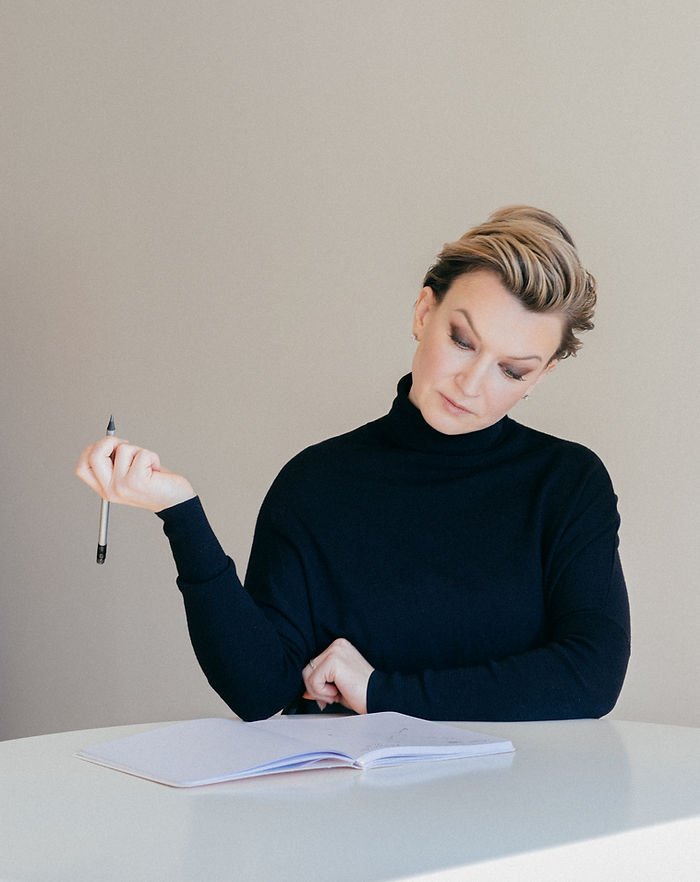

For years, I proofread everything before I let it leave my desk. Not just articles or client proposals. Emails. Comments. A two-line reply to a scheduling question. I would read each one again, then once more, hunting for the wrong preposition, the missing article, the phrase that might reveal what I feared was true: that my English wasn’t good enough for the work I do in it.
English is my second language. I coach senior executives in it. I wrote a book in it. I got my coaching education at Columbia in it, earned my PCC and MCC in it, passed oral assessments in it, taught in it. None of that stopped the checking. Every finished piece of evidence somehow failed to reach the part of me that was keeping score.
Recently I sat for the TOEFL, a standardized test of English proficiency. A strange thing for someone at my stage to do, maybe. The score came back, and something unexpected happened: the fear dissolved. I still make mistakes. My English is not perfect. But I stopped rereading every email three times, and my responses stopped waiting in drafts for days.
My English did not change that day. I simply held, at last, a piece of evidence my inner critic had not produced and could not dismiss. The score was not a compliment I could discount or a kindness I could explain away. It was data. And for the first time in years, I could read data about myself as information rather than a verdict.
That difference — data, not verdict — is what this piece is about. Because the inner critic that kept me proofreading is the same one that keeps talented leaders rehearsing one more time before speaking, rewriting the deck no one asked them to rewrite, and privately waiting to be found out. You cannot argue that critic into silence. I tried for years. But there is another way to work with it, and it begins somewhere most advice about impostor syndrome never mentions.
The Court That Never Acquits
Here is what I have learned about the inner critic, in my own life and in coaching conversations with senior leaders: it runs a court where it holds every position. It writes the charges, evaluates the evidence, and delivers the ruling. And a court like that can never acquit you, because acquittal was never its function.
Watch what it does with good news. A compliment arrives: they were being kind. A promotion: right place, right time. A successful launch: the team carried it. A breakthrough coaching session: I could have done better. A finished book: if they knew how long it took me, they would think differently. Every piece of favorable evidence gets reattributed on arrival — to luck, to charm, to effort, to other people. The achievement is never allowed to mean what it appears to mean.
Psychologists Pauline Clance and Suzanne Imes named this pattern in 1978, studying highly successful women who remained privately convinced they were intellectual frauds. They called it the impostor phenomenon. The “syndrome” label came later and was never theirs — Clance preferred “impostor experience”: something people go through, not something they have. Later research found it across genders and professions, and found something else worth sitting with: achievement does not cure it. Often the opposite. Each new success raises the height from which the imagined exposure would happen.
Clance also described the engine that keeps it running: faced with a task, the person over-prepares — or procrastinates, then works frantically — and when success comes, attributes it to that effort, never to ability. So the ritual must be repeated. My triple-checked emails were exactly this: every flawless message became proof that only the proofreading stood between me and exposure.
This is why reassurance fails, however sincere, however often repeated. Reassurance is testimony, and the critic is free to discredit any witness. What it has a harder time discrediting is a different category of input altogether — one it did not generate, cannot reattribute, and never volunteered to collect.
Evidence the Critic Cannot Dismiss
An external assessment is structurally different from a compliment. The standard existed before I did. The scorers had never met me and had no kindness to extend. The result could not be reattributed to charm, to the team, or to anyone being polite. When my TOEFL score arrived, the critic reached for its usual tools and found that none of them fit. They were being kind — they don’t know me. Right place, right time — it is a timed test with a rubric. The team carried it — I sat in that room alone. For once, the data was not produced by the court.
Once I noticed this, I saw how many such structures already exist, and how rarely we use them this way. Assessments scored by strangers against published standards. Certification programs with real requirements and real evaluators. Formal feedback processes, where observations are gathered with method rather than mood. Supervision, a practice from my own field that I wish every profession had — more on it shortly. Every profession has some version: boards, licensures, portfolio reviews, defended theses.
We tend to treat these things as gatekeeping, or résumé furniture. I have come to see them as milestones that generate evidence. In my field, coaching, the credential ladder is sometimes criticized for reducing an art to levels. Maybe. But a milestone I can point to is data my critic cannot argue with, and that is worth more to me than a purer system that leaves the question of my progress entirely to the loudest voice in my head.
So the advice seems simple: when the critic will not accept testimony, go collect data. Take the test. Invite the structured feedback. Find a supervisor.
Except there is a catch, and it is the most important thing I have to say in this piece. Collecting evidence can calm the impostor feeling — or feed it. Same test, same score, opposite effect. The difference is not in the data. It is in the ground you are standing on when you receive it.
The Catch: Unconditional Self-Acceptance
This July, I began a six-month mentor certification program with Janet M. Harvey. At our first session, she said something I have not been able to put down since: we cannot receive feedback unless we are in unconditional self-acceptance.
Unconditional self-acceptance is not a soft phrase, though it sounds like one. It has a precise history. The psychologist Albert Ellis, founder of Rational Emotive Behavior Therapy and one of the architects of what became cognitive behavioral therapy, made it a cornerstone of his approach. His argument: human beings are incurable self-raters. We take a single outcome and convert it into a global sentence on the self. I failed becomes I am a failure. The session went poorly becomes I am not a real coach. Ellis considered this conversion both illogical — no single performance can summarize a person — and psychologically corrosive. His alternative was exacting: evaluate your actions, skills, and outcomes as honestly as you can, and refuse to rate your worth as a person on any of it. Judge the performance. Never sentence the person.
Ellis would look at my strategy of collecting external evidence and ask a sharp question: evidence of what? If the answer is evidence of my worth, I have not escaped the impostor loop. I have industrialized it. The test score becomes the new proofreading: a ritual that must be repeated, because worth that is proven by evidence must keep being proven. There is always another credential. The bar always moves. I know coaches with walls of certifications who are more frightened than when they started, and executives with flawless track records who are rehearsing harder than ever. Evidence collected to prove the self is the impostor cycle wearing a productivity costume.
But evidence received from self-acceptance is a different act, even when it is the same test. If my worth is not on trial, a score is free to be what it actually is: information about a skill. My English is working. My coaching meets this standard. This competency is still developing. Data, not verdict.
That is what Janet’s sentence reverses. We treat self-acceptance as the reward at the end of growth: once I improve enough, gather enough proof, I will finally accept myself. It does not work in that order, because without self-acceptance the proof never arrives intact. The critic distorts it on entry — inflates it, discounts it, or converts it into a new demand. Self-acceptance is not the finish line. It is the ground. Feedback needs somewhere to land.
And here I have to be honest about my own story, because the TOEFL score did less of the work than I first thought. The reason I could read it as data was not the rubric or the strangers who scored it. It was where I was standing when I opened it. I did not fully understand that until someone else saw it before I did.
Witnessed, Not Claimed
Not long after Janet’s session, I was in supervision with my own supervisor, Meryl Moritz. Supervision, for readers outside coaching, is where a coach brings their actual work to a senior practitioner who helps them see what they cannot see alone. I am a certified supervisor myself, and I still bring my work to supervision — including my supervision work. No level of experience outgrows the need for another set of eyes. Partway through our session, Meryl paused and named what she was observing. What she was seeing in me, she said, looked like self-acceptance.
I had not claimed it. I had not even been working toward it, and I would not have dared use the word about myself. Someone qualified to see it, watching me work, named it from the outside.
I have written before that self-awareness is not something we can simply declare. The research is inconvenient on this point: how accurately we see ourselves and how accurately we grasp the way others experience us are two nearly independent capacities, and what deserves the name self-awareness is verified across perspectives, not asserted from within. Sitting across from Meryl, I understood that self-acceptance obeys the same law. Claimed, it is cheap — the loudest impostors and the most defended egos all claim it. Witnessed, it is something else. It shows up in how you receive an observation about your work while it is still hanging in the air.
And I have to tell you where mine came from, because it was not a technique. It grew out of an intentional spiritual practice I have kept for years — a practice I did not begin in order to fix my inner critic or upgrade my leadership. Self-acceptance was never the objective. It arrived on its own schedule, unexpected, a gift. I am wary of saying this in a blog post, because it resists the format. I cannot hand you five steps to it, and I distrust anyone who says they can.
What I can tell you is what the ground responds to. Not hacks. Not affirmations recited against your own disbelief. Practices — spiritual, reflective, relational — that slowly change your relationship with the one doing the evaluating.
Which brings me to what you can actually do.
What You Can Actually Do
If any of this is landing, here is how I would begin. The order matters more than the methods.
Tend the ground first. Find a practice that is not aimed at self-improvement — spiritual, contemplative, reflective, whatever form is true for you. A practice like this hands the critic no new material. It works further down, slowly changing your relationship with the one doing the evaluating, until there is a self that can sit still while being seen. Alongside it, put at least one person in your professional life whose role is to observe your actual work and tell you the truth: a supervisor, a mentor, a coach — not a cheerleader. What you want is accurate seeing from someone with no verdict to deliver.
Then, and only then, collect the data. Choose instruments the critic cannot cross-examine: assessments scored by strangers against published standards, structured feedback gathered with method, certifications with real bars to clear. Take the test you do not strictly need — that was what the TOEFL was for me. Treat the milestones of your profession as evidence of progress rather than rank, and let yourself count them.
And run the motive test, before and after. Before: ask Ellis’s question — evidence of what? If the honest answer is evidence that I am finally enough, wait. That collection will feed the loop, not quiet it. After: watch what happens when a good result arrives. Relief that settles is data doing its work. Relief that immediately spawns the next requirement — the next credential, the next degree, the moved bar — is the impostor cycle asking for another round. The result itself will not tell you which is happening. Where the bar goes next will.
None of this is a cure, and I would not trust it if it were. My critic still shows up, usually when something matters. The difference is that it no longer runs the court alone. There is other evidence in the room now, and ground to stand on while it is read.
Where This Lives in the Leadership Integrity Framework
Readers familiar with the Leadership Integrity Framework® will recognize where this work lives: in two of the four dimensions. In Purpose — the inner world of leadership — this is the developmental shift I consider foundational: the movement from trying to prove your worth to leading from it. A leader still proving cannot afford accurate information; a leader leading from worth can finally use it. And in Presence, it becomes visible to others, because feedback integration is a practice of Presence. How you receive an observation in the moment it lands — without defensiveness, without collapse — tells people whether your steadiness is real or performed. I wrote in the book that leaders should treat feedback as data, not as a threat to their authority, and that I am selective about which feedback deserves to be worked with at all. Both halves matter. Self-acceptance is not indiscriminate openness. It is what makes discernment possible: grounded enough to let feedback in, clear enough to decide what it is worth.
Imperfect and Working
These days, most of my emails go out after a single read. A few still get a second look — old habits keep their keys for a while — but nothing sits in drafts for days anymore, and when a wrong preposition slips through, it is just a wrong preposition, not the exposure I spent years bracing for. My English remains imperfect and working. I have come to believe the same is true of me.
I keep returning to the order of Janet’s sentence, because it reverses how most of us were taught to grow. Not: improve, prove, and then, someday, accept yourself. But: stand on acceptance, and from there let the evidence — all of it, the scores and the setbacks — arrive as information. Nothing about that order makes the work smaller. It makes the work possible.
So I will leave you with the two questions this piece has been circling. What is one piece of evidence about your work that your critic has never been allowed to count? And what would you need, not to argue with the voice that discounts it, but to stand somewhere it cannot reach?
If those questions stay with you the way Janet’s sentence stayed with me, they will know what to do.
If you’d like to stay connected, subscribe to my newsletter for reflections on coaching, leadership, and thinking with clarity. You can also join my WhatsApp community channel to hear about upcoming community events.