
Your blog category

Hello. I’m Maria Wade.

If you’re here, something in you is reaching beyond the status quo. Maybe you’re a senior leader navigating complexity, making high-stakes decisions, and wondering if there’s a way to lead that feels more whole. Maybe you’re earlier in your journey, still defining your approach. Either way, welcome. This space is for you.

I’m an executive coach, author, and the creator of the Leadership Integrity Framework—a four-dimensional approach to leadership that integrates Purpose, Presence, Partnership, and Perspective. But I didn’t start here. I started in boardrooms, first as a Chief Legal Officer, then as a Chief Financial Officer, navigating mergers, acquisitions, and the particular pressures that come with senior leadership. I immigrated to the United States with my family, rebuilt my career from the ground up, and somewhere along the way, found my calling in helping other leaders grow.

Writing, for me, is thinking out loud. It’s how I make sense of what I’m learning from my clients, from neuroscience, from the messy, meaningful work of real leadership. This blog is where that thinking lives.

What You’ll Find Here

I’ve organized this space around four areas:

Leadership Insights — Practical wisdom for navigating complexity. Posts on communication, feedback, presence, difficult conversations, and the human side of leading at senior levels.

Coaching Reflections — Behind-the-scenes from my practice. What I’m learning, questioning, and discovering through my work with leaders. The patterns, surprises, and quiet transformations that happen in the space between sessions.

Leadership Integrity Framework — Deep dives into the four dimensions: Purpose (your inner world), Presence (how you show up), Partnership (the relational field), and Perspective (systems awareness). This is the framework I developed through years of coaching and wrote about in my book, Leadership Integrity: How to Stay Grounded, Build Trust, and Lead with Wholeness in Uncertain Times.

Book Notes — Reflections on books that shape how I think about leadership, coaching, and human development. Not reviews—more like conversations with ideas that have stayed with me.

Who This Is For

I write for senior executives and the leaders becoming them. People who sense that leadership is more than a role or a résumé line. People who want to lead with integrity—not as a slogan, but as a lived practice.

If you’re someone who doesn’t need another model to memorize but craves a structure that helps you think more clearly, lead more consciously, and act more cohesively—you’re in the right place.

An Invitation

I don’t write to have all the answers. I write to ask better questions. Questions like: Who am I when no one is watching? How do I want to show up when it matters most? What are we building together? What am I not seeing?

These questions guide my coaching, my framework, and now this blog. I hope they’ll become useful companions for you too.

If something here resonates, I invite you to subscribe to my newsletter. I share thoughtful reflections on leadership integrity—meaningful communication, not inbox clutter. And if you’d like to explore where you are across the four dimensions, the LiF Assessment offers personalized insights about your leadership patterns and development edges.

Your thoughts, challenges, and experiences are welcome here. This isn’t a broadcast—it’s a conversation. Bring what you’re wrestling with. Let’s think together.

Welcome. I’m glad you’re here.

S

Maria

I’ve been thinking about a common word we should consider banning from use – in certain contexts, of course. This is the word “when.”

Time and again we hear (and say) these kinds of phrases:

● When I do this thing, then I’ll…

● When I get the next job, then I’ll…

● When I have more expertise, then I’ll…

● When I’m ready, then I’ll…

The list goes on.

The “When I’m…” phenomenon applies to many facets of our lives, but today, I want to talk about it in the context of the coaching relationship.

Recently, I noticed a client was postponing sessions with me. On its surface, this is not a problem. Life happens, emergencies arise. But, when I dug in a little bit with this client she shared that she was hesitant to come back until she had solved some of the new challenges that had come up since we met.

And, this was not the first time in my practice that someone postponed or didn’t schedule their next session.

It’s surprising how often I hear: “As soon as I’m good [or ready] I will come back.”

Now, I should share that I am open to allow my clients to do something that they believe is what they need. What do I mean by this?

It’s okay to….

● change the request for coaching, change the topic or explore something completely different than what first brought you to coaching.

● prepare for a session on one topic, but five minutes before, change the subject.

● plan for a 90-minute session but then ask your coach for less time.

● start your executive coaching program and come in with your personal questions, because when we coach, we’re coaching a WHOLE person.

In other words, it’s okay to have human problems.

Everything happening in your coaching is a good thing.
But I (and I know the majority of my fellow coaches will agree) implore you to come back regardless of where you are in your process.

Unfinished. Unpolished. Not “ready.”

We will help you get ready.

Remember, there’s no useless skills here. If I help you to do something in this project, you can always use this experience in your next project. Invite me in to brainstorm, poke around, challenge and question. You may just unleash your potential along the way.

Thinking about your next job? We will work together to create the right mindset and skill set for your future role, and when the time comes you will be so well prepared because we will have been working together on real life situations. This is what is key here. Not abstract forms or ideas. You have a situation, and you build your skills and mindset on the real-life situation.

One of the best comments a client shared with me was “I feel good about being imperfect with you.”

The messy bits are where the growth happens.

Let’s just imagine we’re all perfect: we look like soldiers… the same space, same order. In our differences and imperfection, however, we create the beauty of this planet. This planet is not something solid and smooth. Everything is diverse. This diversity is what creates life on this planet. It is sometimes dark, light, warm, cold… but, always, good.

Your coach doesn’t want you to show up perfectly. They want you to show up as you.

So, if you find yourself saying “I will do this when…” when it comes to your coaching, your development, or your growth, please take a pause.

“When” can be a killer word.

The answer to “when?”

Now.

I see it all over Instagram.

The intention is positive, but the outcome has the potential to be problematic.

I’m talking about the concept of “finding your why”.

Now, don’t get me wrong. I believe it is good to start to think about this. Our “why” is important. It helps us find meaning and prioritize. It allows us to filter the information we receive and create our perception of the world around us. Two people can look at the same picture, the same tree, the same sky and feel completely different things. This is because of the different “why” they each have in their life.

Our why can be the lens in which we view the world. It can impact what we see, our feelings and our actions.

We ask ourselves: Why am I doing this? It seems simple enough.

And, this is where I believe we really need to come back to: simplicity.

I talk to many people who overthink this task to “find their why”. They have been influenced by the people they follow on social media, they feel guilty for not having a “good enough” why, an altruistic why and some are even intimidated.

Shouldn’t my “why” be grand and big and lofty? Shouldn’t it be “because I want to change the world”?

Maybe. If that motivates you. If that drives you.

But grand, big and lofty actions don’t always need to come from such a huge WHY. In fact, often the most personal, seemingly small motivations can have the biggest impact and enable us to push us forward and meet our dreams.

Examples of Why

What are some other examples of simple, personal but meaningful whys? Here’s a few to think about:

– Because I want to enjoy my life

– Because I don’t know if I’ll like it, but I want to give it a try

– Because I am curious

Maria, you may be thinking. Some of these seem a bit… selfish. They are about me. They aren’t about me saving the world. Can your why really be something as simple as “Because I want to enjoy my life”?

Yes, yes, yes. 1,000 times yes. This is allowed. This is encouraged!

And…why? (joke intended!)

Because. When you are happy and joyful, you show up as your authentic self and are able to bring your unique gifts to the world.

How to Find Your (Simple) Why

Now that we understand that a personal and simple why can be beneficial and important, how do we each find that which is most meaningful for us?

Begin with your personal why by honestly answering some of these questions:

– What do I live for? For whom?

– Why do I live?

– Why do I really want to live?

– What drives me?

– What do I really enjoy doing?

– What do I want to try more of?

It is OK to start on a larger scale and then hone in on specific areas of your life. Your “why” will likely be different for different areas of work, projects, hobbies, relationships or other experiences. And, your “why” may change over time.

Be open to giving yourself the gift of curiosity as you explore your simple why. You’ll inspire others simply by exploring and living out loud.

After all, sometimes the reason for your “why” can be as simple as “why not?”

Photo by Fuu J on Unsplash

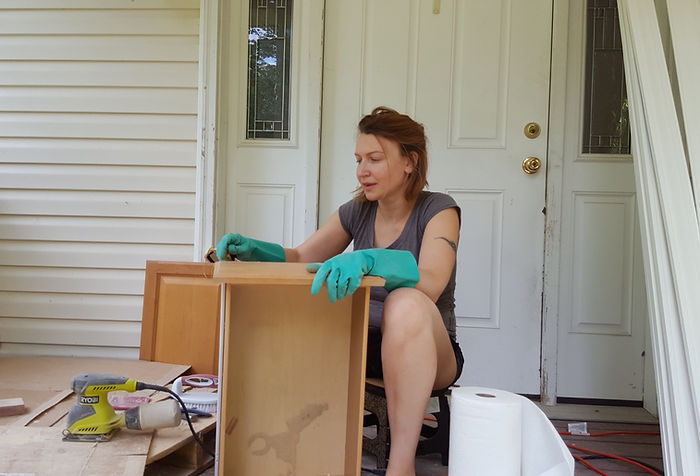
I found a photograph the other day. In this photograph, I am sitting on the porch of our first house here in America. I am removing the paint from kitchen cabinets. I remember that it took hours. I was so proud of myself once this project was complete. I repainted each cabinet; I made them beautiful.

I don’t know if I’ll ever need to use this skill again. I’m not sure if I’ll ever need to remove paint from cabinets or do any type of kitchen refurbishment. Looking at this photo again got me thinking: Does that mean this was a wasted skill to learn?

I remember hearing this sentiment a lot as a child and maybe you heard some version of it, too: “When you leave school, just forget about what you learned, because you will never need it again.”

This stuck with me.

And, the comments continued.

“When you come to work, forget everything you learned at university because you won’t use it.”

What is the message here? You are investing a lot of time in learning, but you won’t need this in your life.

Do I agree? Do I feel that skills obtained that go unused have been a waste of time? Something worth forgetting?

It might not surprise you to hear that I say “no”… My take is that there is no wasted learning or wasted skills because you never know what you can use in the next moment.

Sometimes it will be a direct connection and sometimes it will be indirect.

For example, I learned how to milk a goat. Yes, it is true. And, where can I use this skill again? I don’t plan on spending too much time around livestock any time soon…

But here’s how I think about it (and this is where the “indirect” connection comes in): It’s not exactly what I learned. It is often the mindset, perspective, experience, or secondary skills gained that are what sticks with us the most. Often, a lesson learned may even be (unknown) preparation for something awaiting you in your future.

When it comes to that cabinet work? This showed me that I can do physical labor and I enjoy doing this. It really calms me down and has helped me see that whatever happens in my life, I can deal with it. I can take on challenges and overcome the unknown.

Another example: baking. How to make a perfect cake is not the only thing I have learned from baking. I also honed my ability to appropriately allocate my time and attention, to complete several tasks simultaneously and to pay attention to many items in my head while keeping the big picture in mind. Said another way: I applied my project management skills to a new hobby.

Ultimately, we don’t know what, when and how we will use the many skills and experiences we pick up, but I dare say there’s no such thing as a useless skill.

And if you happen to hear of anyone needing their goat milked… you know where to find me.

All the photos are provided by Maria Wade.

After my recent post, (Create Your Perfect Day), I received a response that allowed me to reflect even more on this topic. A colleague shared my strong opposition to this idea of “where you see yourself in 5-10 years” and talked about some additional pitfalls in this approach.

The truth is, when we approach our goals in terms of a specific role or title — versus how we want to spend our time — we often limit ourselves from exploring what is possible.

I know because I experienced this firsthand.

When I moved to the United States, I thought a lot about my prior experience and my career in Russia. I decided I wanted to verify all of my credentials here in America. I passed multiple tests, regained my PMP – Project Management certification, obtained Change Management certification, and started applying for jobs.

I faced a lot of rejections. This discouraged me from further attempts to look for a job in the space

where I had previously developed my expertise. I was basing my decisions on prior roles I’d had, what I was qualified “on paper” to do and what made sense as a next step for me. Little did I know that these rejections would change my life – for the better.

In the midst of this experience, I did the Perfect Day exercise. I imagined myself working with people, sharing thoughts, giving ideas

and asking questions. I shared this with a friend of mine who asked me straightaway: What about coaching?

Why am I sharing this story? Why is this important?

Because when I was focused on a specific job, a specific role, I faced a lot of rejection. I could have really savored the negative side of this situation but instead, I created a

picture and said let’s forget about that previous part of my life; I will take everything available but in some kind of new frame… let’s see where this will take me.

That was five years ago, and it was the minute I started exploring this beautiful trade of coaching. It is the work I do now, that I love, and I have never been happier. I know my purpose and I live a very fulfilling life.

We often think we know what is best for us. We put a lot of stock in a specific role and job, when – instead – we can begin, together, to create a new culture. A culture of dreaming without boundaries and without attachments to titles, companies, and roles. Ask yourself: What would I really enjoy doing? How can I add value to my life and the lives of others?

So, what now?

Here are my questions to you: Are you unhappy in your current role? Are you dissatisfied with options for mobility within your company? Are you looking around and wondering what is next for you? Are you considering what will bring you joy and purpose and fulfillment?

If so, I invite you to complete the Perfect Day exercise, and take these steps on the path to transformation with me.

All it takes is a willingness to see the possibilities. Are you with me?

Photo by @OlgaPrudka

I used to ask my clients where they see themselves in 5-10 years. I stopped asking this question

because I now find it irrelevant and generally unhelpful for the vast majority of people.

I don’t believe in perfect predictability. What if something changes? What if you reach your goals more quickly? What if you change course? Have you failed? For me, a 5-10 year plan feels quite rigid. I don’t want to limit people.

What I have found more helpful in my practice (and in my own life) is a classic exercise; it still works and is unchanged after many years because it works so well.

I have now replaced the question “Where do you see yourself in 5-10 years?” with “Tell me about your perfect day.”

Your perfect day.

But, one, single, solitary day cannot possibly give you any insight into your future… or can it?

Here is how the “Perfect Day” exercise goes. You think about what you want a day in your life to look like. You don’t put your focus on the how or the when. Instead, you focus on the what.

Write about the perfect day. Visualize this perfect day. You can even play around with your brain a little bit because our brain doesn’t realize if this is a real experience or an imagined one. We can rely on its ability to look for and find patterns.

You can also customize this experience. For example, a client of mine mentioned that she actually has extremely different expectations from her working days and weekends. She wants to see her weekend differently and so we separated the two and she identified her ideal days for each.

Another client shared she was in the process of using this exercise. She was looking around and stumbled on a chair and she immediately had the thought: This chair is a part of my perfect day. I asked her whether she had a picture of this chair and we created a folder with this picture. All of this helps increase the effect from this visualization work.

The beauty of this exercise? You don’t have to wait 5-10 years to get what you want. You already have some things from this day in your current day. By looking at these things you can complete this picture in your head.

But, writing and visualizing are not the end. They are merely the beginning. The real exercise is when you regularly read what you have written about your perfect day. This enables you to frequently remind yourself about your vision, purpose and reason. And, this imagined day is organic and flexible and always relevant. If something changes in your life, you can change your day.

This is your instrument to play.

I, personally, like this exercise because it helps me – and my clients – to navigate through uncertainty and complexity. There is a comfortability and an ease in thinking about the future in this way. It helps you stay motivated and encouraged.

So, to the question “Where do you see yourself in 5-10 years?” you now have an answer… living out my perfect day!

Try your own Perfect Day exercise. What do you learn? What surprises you? What’s something you can change today to help get you one step closer?

P.S. Click HERE is you want to get some tips and questions from me to create you OWN PERFECT DAY

Read also The Way to Your Dreams: Create Your Perfect Day Part 2

I am an optimist.

Is this a bad thing?

Well, I hear a conversation happening in many circles right now.

Just think positively. Or… Feeling down? Engage in uplifting self-talk. Or… Everything happens for a reason. Or… Choose to be happy.

None of these sentiments, on their surface, are bad things, but I do want to caution you about being overly-optimistic.

But, have you ever even heard of being “overly-optimistic” or “too positive” or “too resilient”? Is this even a thing?

Let’s dissect this concept a bit.

What’s Happening Behind Toxic Positivity

There are many people out there who engage in a consistently positive attitude, no matter the reality. They believe complete positivity is the answer to achievement and to avoiding failure, to attracting the “right” relationships and to moving through life unhurt and without fear. They believe that since we can make a choice to be happy and just be happy, that we should.

Don’t get me wrong. I love joy! However, when positivity, optimism and resilience are solely manufactured, I believe it is time to step back and take stock.

But, Maria [you may be thinking to yourself]… if I’m not working at being optimistic all of the time, then I am bound to feel… well… a whole range of other emotions. Like…even negative emotions! I might feel sad or bad or unhappy or jealous or angry or frightened or disillusioned or concerned or melancholy or…

Yes, I get the idea. And yes, this is true.

But to live in a state of forced positivity and to white-knuckle ourselves to happiness is counter-productive to our growth, our truth and our peace.

To force positivity is to deny reality. And this creates a distance between those who try to do this and their friends, family, colleagues, and acquaintances, because individuals who force this positivity will appear to be out of touch with an entire range of emotions. They often lack an understanding of how people can be upset or hurt. They can lose their compassion and their empathy.

In my practice, when I engage people experiencing negative emotions, I let them know this is okay. After all, this is what really makes us different from any kind of species: we have our emotions. I do not suggest my clients reframe negative emotions or talk themselves out of them. That would only serve to deny their experience.

Negative emotions are something we need to understand and acknowledge. To explore. And even sometimes to savor.

We can sit with not only the what of the emotion, but the why of the emotion.

Negative Emotions

We’ve traditionally viewed negative emotions as indicators that something isn’t functioning as it should. Sometimes, we may even feel ashamed for experiencing them. In practice, I’ve observed that male clients are surprisingly more willing to explore their negative emotions, whereas female leaders tend to deny them by ignoring or suppressing. The reasons for these observed differences could be the subject of another blog post. For now, I want to emphasize that negative emotions are invaluable; they prompt us to analyze and reflect.

Let me reiterate for everyone: Emotions have often been viewed as indicators or built-in reactions. However, they are not your permanent state. And here’s a fascinating twist: our nervous system doesn’t categorize emotions into ‘bad’ and ‘good.’ This insight invites us to reevaluate our emotions repeatedly.

But what if we shift our perspective, following the insights of Lisa Feldman Barrett, and see our emotions not just as indicators but as predictions? This understanding transforms our approach. Emotions then become our brain’s predictions based on past experiences, suggesting how we might react to similar situations in the future.

So, let’s take these negative emotions we experience. Instead of ignoring them, let’s understand them as predictions and use them to our advantage. Initially, let’s acknowledge them without attempting to dissect each one. Then, let’s examine these emotions under a new light: What do I predict? How can this foresight serve me? What does it teach me about my anticipated reactions? What insights do I gain about myself that were previously obscured?

To move beyond these predictions and not let them define our reactions, we can engage in activities such as breath exercises, meditation, or physical activities. These practices help us to reframe and rewire our brain’s predictive models. We’ll be optimists, but of a different kind—thoughtful and conscious.

Remember, reevaluating our emotions as predictions isn’t a quick fix. While we might outsmart our brain temporarily, our body’s wisdom isn’t easily bypassed.

This approach is a choice. A powerful choice. You decide how to interpret and use these predictive emotions. You can release them, or you can explore and play with these anticipatory feelings—mindful, though, not to let them deplete your energy.

For a deeper understanding of emotions as predictions, I highly recommend checking out Lisa Feldman Barrett’s insightful explanations on this topic.

Time to Reflect

The next time you feel a negative emotion surfacing, see what it feels like not to stuff it down, not to reframe it immediately, not to suppress it, or push it aside in the name of (toxic) positivity.

Explore what it feels like to acknowledge it. To examine it. To peel it back a bit and uncover something valuable from it. To thank it for providing some insight for you.

And then, to start planting the seeds for new, better predictions. You’re the only person who can make changes in your life.

Believing in you,

Maria

I want to share a recent experience with you that stopped me in my tracks.

Initially, it was something that brought me a lot of pride, but quickly, that pride turned into concern. Should I feel pride for getting something done even if it means running myself into the ground?

My answer: An unequivocal no.

Here’s what happened.

I needed a video completed.

So, I decided to do this all myself. And when I say I did everything myself, I mean, I did everything myself. I wrote the script. I set up my camera and my sound. The quality was not that great, but who cares? Perfection is the enemy of the good (and complete). I edited the video once it was done. I created a thumbnail for this video. And I did not stop there. I found free music I was permitted to use for the video and put it all together. To finish off, I added subtitles.

Finally, after many steps and stumbling blocks, I posted the video.

At first, I was very proud (and I do still think it’s pretty cool I figured out how to do that stuff).

But, if I look closely, I can find something wrong at every stage of this. I do not wish to go into film production. I do not want to become a studio producer. I needed to put off other things in order to complete this. So where did I falter?

Examining this scenario, I realized the one (big) thing missing: I did not properly delegate.

If you have a lot on your plate, it is probably time to invite someone and share your dish.

Life, work…everything can feel overwhelming sometimes. You have a never-ending to-do list, and there aren’t enough hours in the day for all you need to get done. You feel drained.

Here’s the truth: You can do many things yourself. You have many talents. And, maybe you want to work things out on your own for a variety of reasons. Perhaps it is important for you to save some money. Maybe you’d like to explore new skills because you’re curious. These are all valid reasons to take things on yourself, especially in the short-term with quick turnarounds.

But, when it comes to the longer-term, I take a different view.

When you engage in many tasks, you are spreading your energy and your precious focus and attention on something outside of the scope of your big goal… outside of the scope of your WHY.

I understand, for many of us that feel the need for control over all aspects of our lives/work/business/environment, we may be worried something will go wrong or something will be ruined if we let someone else get their hands in the pot.

But, if we can begin to surrender some of this control, we will begin to realize that there is very little we need to truly manage ourselves in the long-run. Freeing our time a bit allows us to engage in activities that are really meaningful and drive purpose for us.

And, yes. Asking for help can feel scary.

It can seem like you are begging or that you are promoting your inability to do something.

Do not be afraid to ask for help.

Asking for help shows you are strong enough and brave enough to ask. If you are in a leadership role, this is even more powerful. I promise, it will demonstrate your strength.

Check your thinking preferences (ask me about the NBI profile to determine your preferences). If it’s a one time task you can focus on and be done with it: do it. You can do anything.

But, evaluate your longer-term projects and decide what to keep for yourself, and what to delegate.

What might it look like to take the longer view?

● In a corporate environment: You can reconsider your job description or your team members’ job descriptions. If you have the flexibility to allocate the workload differently, bring up the topic to discuss. Invest time in figuring out what people like to do and enable them to do their favorite work. If you have less control, engage with your partners; take advantage of the resources around you. When in doubt, ask. You never know what might be possible.

● If you own your own business: The answer isn’t always jumping to hire a costly professional, though it may feel tempting. You may be able to teach someone how to do what you need. It can be a win-win, as they may be excited for an opportunity to learn the ropes with you. Hiring or partnering with other entrepreneurs can be mutually beneficial. Explore barter options. Get creative!

● In your personal life: Do not be afraid to ask family members and friends to help you. Remember, this is not a sign of weakness, but of strength, and you will be modeling for all of those in your life what strength can look like. This can unite you even more with your loved ones.

My final word: No matter how independent, self-starting (or stubborn!) someone is, I always advise to hire a professional, when reasonable, in these two situations as a non-negotiable: taxes and health & safety.

Take (Small) Action Now

How can you find out what you want to keep on your plate and what you wish to delegate or share with others? Complete the exercise I call “My Perfect, Beautiful Day.” Close your eyes and imagine your best day… what are you doing, what are you NOT doing, and how do you feel?

Now, what’s one thing currently on your plate that didn’t show up in your Perfect, Beautiful Day, and who can you ask for help to get it done?

Enjoyed this post? You may want to explore my series on time management. The latest post is here.

Photo by Austin Distel on Unsplash

Breathe! It’s safe to breathe.

We generally take our breath for granted. Breathing is automatic. You don’t need to remember to breathe when you go about your day or when you sleep. The respiratory center at the base of our brain controls our breathing subconsciously.

That said, you can take control of your breathing if you want. For example, you can hold your breath staying under water or train it for speeches or singing. 

But, have you ever noticed how often you hold your breath subconsciously?

In his Psychology Today article, “Waiting to Exhale,” Alan Fogel, PhD. provides us with some insight. “Usually, breath holding occurs under stress or threat. It can also occur when we are anticipating something or wanting something to happen: this is the origin of the phrase, “Don’t hold your breath!” when expected things may not come true.”

When given the choice, most of us would say that we yearn to stay in a state of “relaxed breathing,” however, we likely don’t even not even realize when we switch over to what is called “effortful breathing.” Fogel goes on: “effortful breathing…[is] not healthy because the muscular effort, coupled with the effects of stress on the nervous, hormonal, and immune systems, can impair both physical and psychological function.”

Not all breathing is created equal.

In addition to effortful breathing, I’m going to share another type of breathing with you. Have you ever heard of the term “screen apnea”? Screen apnea is a breath hold or engaging in shallow breathing while you’re looking at the screen. Looking at a screen…this something many of us do for hours a day without even thinking about it!

As shared in this Business Insider article, studies have shown that we can go into a state of “shallow breathing, breath-holding and hyperventilating” when we are in front of our screens. This action triggers “the sympathetic nervous system toward a fight-or-flight state” and our bodies are physically getting ready to take serious action. “Our bodies are tuned to be impulsive and compulsive… we also become tuned to over-consume.”

Said another way: Have you ever been scrolling through Instagram only to look down and notice an entire box of cookies is gone. Who came in and stole these without my realizing it? you may ask yourself, as you wipe the crumbs from your shirt. This is all a result of screen apnea. “In this state… we reach for every available resource, from food to information, as if it’s our last opportunity— pulling out our smartphones again and again to check for e-mail, texts and messages.”

How can we approach breathing with intention? The answer is simple: breathwork.

We now know a bit about what kind of breathing we want to stay away from, but is there a way to remedy this?

The answer is yes. We can move away from effortful breathing and into intentional or controlled breathing. This is breathing that actually helps and supports our bodies and our minds.

As the reading on screen apnea notes, “Deep and regular breathing, also referred to as diaphragmatic breathing, helps to quiet the sympathetic nervous system.” The next time you pick up your phone to check email or send a text, see if you can get in tune with your body. Notice how you feel physically. Approach your breath with intention. But, this isn’t just about being mindful of our time on our screens. This is about intentional breathing in all situations.

While various breathing practices have been known for centuries, studies are merely beginning to reveal the benefits of controlled breath, also known as breathwork. It has been found that breathing practices can help reduce stress, burnout, anxiety, hormonal imbalances, sleep issues, depression, and other disorders. It can improve circulation and blood pressure and even increase anti-inflammatory activity.

Who can benefit from breathwork?

You may think that breathwork is for individuals who are intensely struggling or suffering. You are right; breathwork is very supportive for stress, tension, overwhelm, fear, anxiety, burnout, and more. But breathwork is also beneficial for people who are stepping up to the next level in self-compassion, gratitude, clarity, consciousness, and connection.

I was personally introduced to breathwork one year ago and fell in love immediately. Breathwork became a life-changing experience for me. Now, I run free-of-charge breath clubs in two languages – English and Russian – offering one-on-one sessions, sessions for small groups, and intensive programs. As a result, we’re building strong conscious and connected communities of people who are transforming themselves and their lives.

Curious to try?

Join me at my Breath Club “Conscious and Connected” each month for breath sessions. These sessions are free and open for all whether this is your 1st or 50th breathwork session. We start with a meditation and continue with a conscious, connected breath technique.

New to breathwork? Don’t be intimidated with the novelty of this experience. I will stay with you at every step of your practice.

When you need additional support, close your eyes and imagine yourself in the center of the circle with us holding each other’s hands and sending you our love and support.

Do you feel stronger now?

P.S. I’m adding this update on July 27th, 2022. I’m not facilitating breath sessions now, but I breathe each Sunday with Alchemy of Breath – they offer free sessions to anyone who is interested. Check their sessions here.

Note: This blog is part of a series of posts about time management. Check out my first post here.

Time… My best friend and my worst enemy.

Do you feel like me? Do you feel that there is never enough time? We spend it, plan it, waste it, optimize it and still want more of it.

Here’s the reality…

We cannot manage time.

Coming from a time management blog series, this may seem like a surprising position for me to take, but let me reframe to explain what I mean.

When it comes to “time management,” I believe the only thing we can manage is the focus of our attention and the work and tasks we’re doing. We need to create a system to follow. We need to master the system to make it efficient.

As I work with leaders to increase their personal and professional effectiveness, I’m actively searching for ways to create more time without being stressed and overwhelmed. All of my clients note that, as a time management expert, I have quite a peculiar approach to the whole idea.

What does time management really mean? To stop time, to slow down, to speed up, to cancel? I haven’t learned how to do any of this yet. So, I don’t try to do any magic in this area; my magic is in shifting the focus into a different direction.

Fun fact: When a client complains to me about time issues and poor ability to manage time, my first question is “Tell me about your breakfast and sleep”. I learned this from Jordan Peterson, a Canadian clinical psychologist. (Check out this short video about breakfast).

You will make better decisions when you feel good, not when you are under stress or hijacked with anxiety.

Additionally, sleep is the most accessible free drug that will make your life longer, and help you to improve your memory, health, and mood. It will make you happier, less depressed, and less anxious. I love the book Why We Sleep? by Matthew Walker, PhD where he provides scientific proof for all the benefits of sleep in a very digestible and comprehensive manner. I highly recommend this book. It will literally change your life; it has changed mine.

My second question is about the system(s) that you use to get things done.

The most popular answer is a to-do list. Great. (Using a to-do list is something that we will explore more in future blog posts).

Some follow up questions: How many items are on your to-do list? What is the nature of the items on your to-do list? Are these actions or ideas?

Why does it matter? The ideas will keep you overwhelmed; actions will move you forward.

If you move through your to-do list slowly and often don’t feel motivated to take action, it’s probably time to ask yourself why you have to take this action. Where is the place for this item in your big picture? When you know why you “need” to do things, the motivation required will naturally be there. Normally, we don’t want to do things that we don’t see as necessary for completing the big picture.

So, I invite you to try this very simple system:

● Have a healthy breakfast each morning

● Create a healthy, consistent sleep routine

● Ask yourself each time you will put a new item on your to-do list why you are adding it and where is the place for the item on your big picture map

● Make sure that you have actions – not ideas – on your to-do list

● Try to focus on how to remove things from your list rather than add new ones

● Count hours required for each action on your list to make sure that your plans are ambitious but still realistic

● Look at managing your tasks as a fun game. Create rules that will work for you. You are the owner of your system and you can adjust it to your unique needs.

Are you interested in learning more about “time management” tools and techniques?

Do you want answers to questions such as: What is a good use of time? What can we do to reduce time pressure? How can I avoid feeling that I am constantly pushed to do what I don’t want to do? How can I stop perceiving time as an enemy? How can an effective system of managing your tasks improve my well-being?

Stay with me. Let’s continue this path of exploration of the idea of shifting our perception of time.

If you’re interested to learn more, you can watch my videos from Time/Task Management Series:

Photo by Olga Prudka