
Behind-the-scenes thinking from an executive coach’s practice. These posts share what I’m learning, questioning, and discovering through my work with senior leaders—the patterns, surprises, and quiet transformations that happen in the space between sessions.

I wrote recently about a senior vice president who lost his succession plan one month before his transition. That post walks through the framework: how the four questions helped him find his footing when everything collapsed.

What it doesn’t show is what happened on my side of the conversation.

I want to share some of that here, because I think it matters. Not because my experience is the point, but because coaching through a crisis like this one sharpened something for me: the moments that look like emergencies for our clients are often invitations for us as coaches to notice what we’re doing with our own uncertainty.

When he called me, two days after the news broke, I could hear the speed in his voice before he said a word. He was already in motion. Already solving. And my first instinct, if I’m honest, was to match his pace. To be useful. To help him think through the options.

I caught myself. Not because matching his pace would have been the wrong thing to do, but because something in my body was telling me this wasn’t a thinking problem yet. It was a grounding problem. He needed to land before he could lead.

The pull to rescue

That instinct to be useful is one I’ve learned to watch in myself. It shows up most when a client is in real distress. They’re activated, the situation is urgent, and there’s a pull to meet that urgency with solutions. To step in. To rescue. It feels like helping. Sometimes it is. But I’ve been a coach long enough to recognize when that pull is about managing my own discomfort with their pain, not serving their actual need. (There’s a name for this pattern, and I’ll write about it soon. For now, I’ll just say: if you’ve ever felt the urge to fix someone’s problem before they’ve finished feeling it, you know exactly what I mean.)

With this leader, the actual need was simpler and harder than problem-solving. He needed someone to sit still while he figured out who he was in this new situation. Not who the board expected him to be. Not who his team needed him to be. Who he actually was, now that the plan he’d built his identity around had just collapsed.

I asked him one question in that first session: “Before we get to what you’re going to do, can we stay with what just happened?”

He resisted. Politely, the way senior leaders do. He pivoted to logistics, to timelines, to the names of two people who might be interim candidates. I let him go for a few minutes. Then I said, “I notice you haven’t taken a breath since we started.”

He paused. And in the pause, something loosened, and what surfaced wasn’t the strategy session he’d been bracing for. It was grief. He’d spent four months letting go of this role, psychologically handing it over. Our coaching had been intentionally focused on staying present while preparing for what came next, holding both timelines at once. And now he was being asked to step back into something he’d already released. That disorientation was real, and it needed to be acknowledged before any useful thinking could happen. This is the part of coaching that normally doesn’t make it into frameworks or blog posts. The willingness to not be helpful yet. To trust that the client’s system is processing something important, and that my job is to protect the space for that processing, not fill it with questions or models.

The moment that surprised me

Two weeks later, at our regular session, something unexpected happened. He’d done the work: reconnected with his values, slowed down his pace, brought his team into the conversation. All the things I’d written about in the framework post. But in our session, he said something that caught me off guard.

“I’m glad I lost my successor. Not glad it happened, but glad it happened while we were working together.”

I wanted to hear more.

He explained: the four months of transition planning had been comfortable. He was passing the baton, wrapping things up. Even though our work together had been focused on staying present during the transition, he admitted he’d been mentally drifting toward the next role. The crisis forced him to look at things he’d been avoiding: a role that was poorly designed, a team that had been holding back concerns, a leadership pipeline that had no depth. None of that would have surfaced if the handoff had gone smoothly.

What struck me in that moment wasn’t the insight itself. It was the quality of his voice. Two weeks earlier, he’d been running on adrenaline. Now he was speaking from a settled place. Not calm, exactly. Present. I notice that difference in my body before I notice it in the words. His breathing had slowed. His sentences were longer. He was thinking in the conversation, not performing for it. That settling is what I listen for as a coach. Not the breakthrough moment, not the dramatic shift, but the point where a client stops managing the crisis and starts actually being in their own leadership again.

What I took from this

Every coaching engagement teaches me something, but this one clarified a pattern I’d been sensing for a while. The leaders who come through crisis most whole aren’t the ones who solve it fastest. They’re the ones who allow themselves to be disoriented by it first. The disorientation is the data. It’s telling them that their old way of understanding the situation no longer fits, and something new needs to form.

My job in those moments is to resist the pull toward premature coherence. To let the not-knowing sit long enough for genuine clarity to replace the manufactured kind.

It’s harder than it sounds. I have my own relationship with uncertainty, my own instinct to organize and make sense. Sometimes the best coaching I do is simply catching myself before I impose structure on a client who isn’t ready for it yet. If you want to see how this leader’s crisis played out through the lens of the framework, that post is here. This one was about what happened behind it.

A Note from the Author

If this case stirred something in you—curiosity, recognition, maybe even a little unease—you’re exactly the kind of person I had in mind when I decided to open it up for live conversation.

In March, I’m hosting two free Case Study Debriefs on this same crisis:

We’ll walk through what happened, what was at stake, and how the Leadership Integrity Framework™ shaped both the leader’s choices and my own as a coach. You’re welcome to bring your questions, your own parallel cases, or simply your curiosity. This space is for executive coaches and corporate leaders who are committed to supporting others when things are not neat, not tidy, and not theoretical.

If you’d like to stay informed about future case discussions, workshops, and new resources, you’re also invited to join my WhatsApp community for short, thoughtful updates (no more than one or two a week):

I’d be glad to have you in the room.

Warmly,

Maria Wade

There’s a special kind of joy in seeing your ideas take flight. Recently, I had the honor of contributing to a collaborative article where I shared how a simple executive coaching technique created a profound shift in a client’s leadership skills.

It’s a reminder of how leadership coaching—whether part of a transformational coaching program or tailored as executive leadership coaching—can lead to significant results. In this case, the focus was on helping a senior executive cultivate emotional intelligence and resilience, which transformed their leadership style and team dynamics.

Below is my contribution to the article. I hope it inspires you to consider subtle shifts in your own leadership style. For more insights from other premium coaching professionals, feel free to explore the full article here.

Transformational Coaching Program: Cultivating Emotional Intelligence

One of the most transformative coaching experiences I’ve had involved guiding a senior executive in cultivating emotional intelligence and resilience—key attributes of effective leadership. This executive, while highly skilled and knowledgeable, struggled with managing stress and maintaining composure during critical situations. These challenges impacted his ability to lead with confidence and inspire trust within his team.

To address these issues, I employed a combination of mindfulness practices and cognitive restructuring techniques, grounded in principles of neuroscience. These methods were carefully chosen to help the executive rewire his responses to stress and develop a more reflective and adaptive leadership style.

The first step was to enhance his self-awareness. Through guided reflection, he became more attuned to his emotional triggers and learned to recognize the underlying patterns that led to reactive behaviors. This increased awareness allowed him to pause and choose more constructive responses in high-pressure situations.

Next, we focused on building emotional resilience. By incorporating regular mindfulness practices, the executive learned to recognize the emotion and stay grounded and calm, even in the face of adversity. These practices not only helped him manage his stress more effectively but also improved his overall emotional regulation, enabling him to lead with greater empathy and clarity.

In parallel, cognitive restructuring exercises were introduced to shift his mindset from a reactive to a proactive one. We worked on reframing negative perceptions, which had previously fueled his stress responses, into opportunities for growth and learning. This shift empowered him to approach challenges with a solution-oriented mindset, fostering a more positive and resilient leadership style.

The impact of these techniques was profound. Over time, the executive reported a significant improvement in his ability to handle stressful situations with poise and confidence. His team reported on his newfound ability to lead with calm authority and to inspire a supportive team environment.

This experience underscored the power of combining mindfulness and cognitive restructuring within a coaching framework. By addressing both the internal and external aspects of leadership, we were able to effect lasting change, enabling the executive to not only improve his own leadership skills but also to elevate the performance and morale of his entire team.

P.S. With this case study, I wanted to demonstrate how executive coaching can go beyond addressing immediate challenges to foster deep, lasting transformation. By focusing on emotional intelligence and resilience, leaders not only enhance their own capabilities but also create a more positive, empowered environment for those they lead.

If you’re seeking to elevate your leadership or inspire similar growth within your team, these insights may offer valuable steps forward. Don’t hesitate to reach out to me to discuss your ideas with me.

Warmly,

Maria W.

Nine years ago, I stepped onto American soil, a land so vast and different from where I’d come from, carrying a suitcase, a wealth of experience in various high-stakes industries, and a heart full of dreams. My past roles—navigating the complexities of mergers and acquisitions, leading a nationwide customs operation, managing a billion-dollar company—suddenly felt like chapters from another lifetime. Here I was, ready for a new chapter but unsure where to start.

The world of coaching unfolded to me through a conversation with a dear friend, Yakov, a suggestion that sparked curiosity and, soon after, a passion. It was as if all my previous experiences were converging, preparing me for this moment. The skills I had honed over the years in leadership, strategy, and finance were about to take on new meaning.

The Columbia Coaching Certification Program was my gateway into this new world. As a non-native English speaker, the initial dive into coaching practices was both exhilarating and daunting. I remember the “fish bowl” sessions, where we practiced coaching under the watchful eyes of peers and mentors. It was here, in moments of vulnerability, that I found strength, supported by a community that valued diversity and personal growth.

The program wasn’t just about learning the mechanics of coaching; it was about finding my voice within the coaching space. It taught me the importance of listening, not just to respond, but to understand and empower. Coaching became more than a profession; it was a calling, a way to make a meaningful difference in people’s lives.

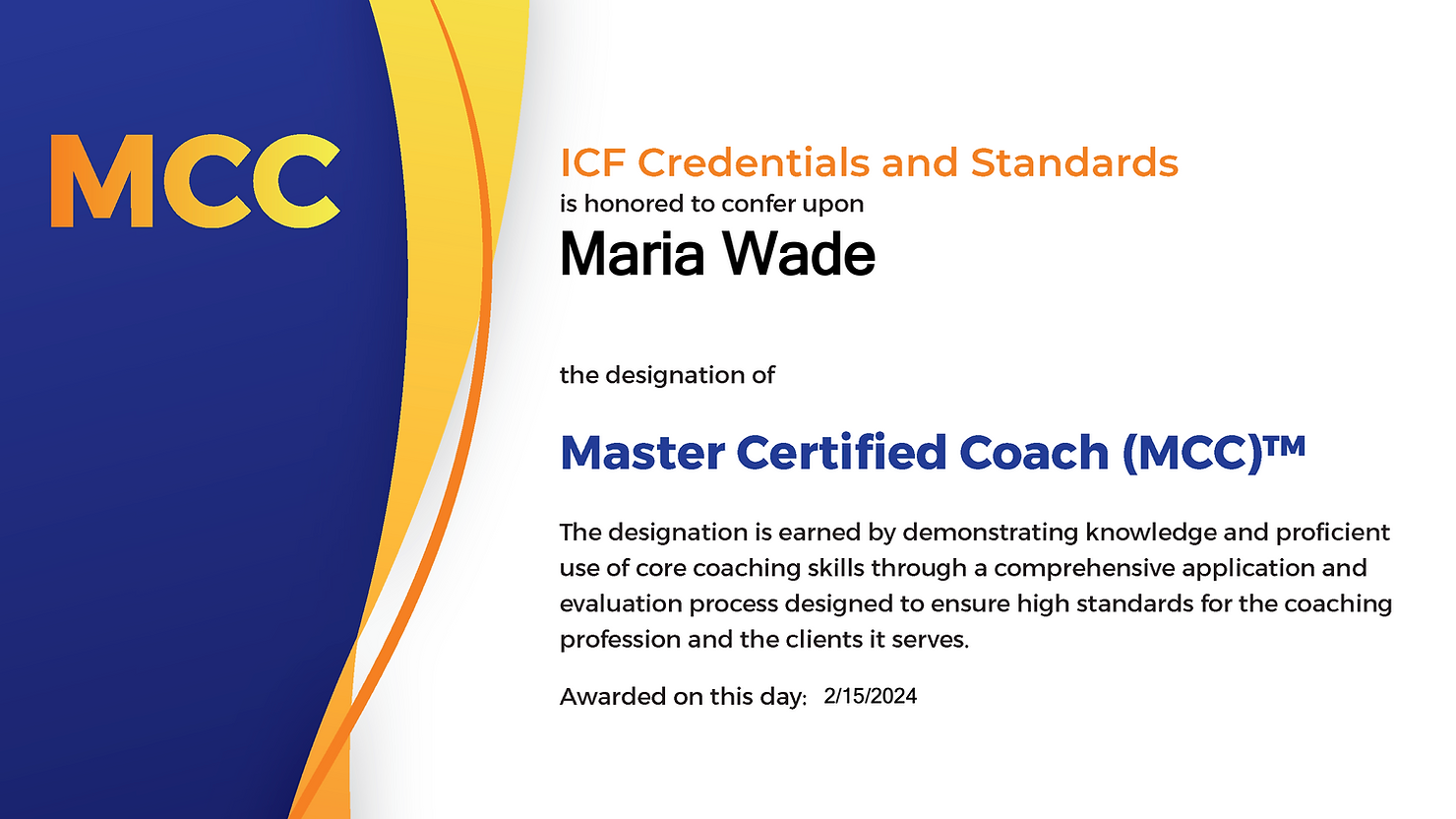
Achieving the Master Certified Coach (MCC) credential from the International Coach Federation was a landmark in this journey. With over 380 hours of education and training under my belt, this wasn’t just a testament to the skills acquired; it was a reflection of the deep, transformative journey I had embarked upon.

But this journey was never just about the destination. It was about the people I met along the way, the mentors who guided me, the clients who entrusted me with their stories, and the colleagues who became companions on this path. It was about the continuous cycle of learning and giving back, of growing as an individual and as a professional.

Now, as I stand on the precipice of new beginnings—writing a book on Executive Presence, leading initiatives as President of the Columbia Coaching Learning Association—I’m reminded of the essence of this journey. It’s about connection, resilience, and the never-ending pursuit of excellence.

Reflecting on the past nine years, I see a tapestry of experiences, challenges, and triumphs. From the boardrooms to the intimate spaces of coaching conversations, it’s been a journey of discovery, not just of my potential but of the profound impact we can have on each other’s lives.

This story, my journey, is a testament to the power of human connection, the beauty of embracing change, and the joy found in pursuing one’s passion. It’s a reminder that sometimes, the most unexpected paths lead us to the most rewarding destinations.

And so, to those who’ve been part of this journey, to the mentors, clients, friends, and family who’ve supported me every step of the way, thank you. Your belief in me has been the greatest gift, fueling my journey and reminding me of the impact we can make when we walk together.

I can only imagine the journey ahead, the stories yet to be written, and the lives we’ll touch. The path from boardrooms to the heart of coaching has been anything but linear, but what a beautiful journey it has been.

My mission is to help people thrive through complexity and uncertainty. I’ve been thinking about this concept lately. The opposite of uncertainty is obvious: certainty.

But, is certainty always a good thing?

There are so many factors that lead to our sense of certainty and, we can all agree, that if nothing else, the last 2 years of a global pandemic have thrown our ability to declare anything as a “safe bet” out of the window.

So here’s the nuance. While I can’t provide certainty, what I can provide is getting you more comfortable with the unknown.

It might surprise you, but I don’t want you to become certain. I want to encourage you to stay open-minded instead. Why? Because we just never know. We never know what is truly good or bad for us. We never know what is just around the corner. We can collect information and examine many sources, but I know, for me, that the moment I am certain, I stop.

I freeze in this certainty.

I could promise you that getting more and more certain would improve your decision making process. After all, a sense of certainty calms you down. You’re certain. You’re relaxed. You’re calm.

But the key words here are “a sense of…”

Certainty can look so real. You can fool your brain and rationalize everything. By trying to create certainty, we establish our assumption as something true. This is why I believe that certainty eventually makes you a prisoner of your own illusions.

This is why I cannot help people get to certainty.

What Kind of Circus Performer Are You?

This is like working in the circus.

Just hear me out on this.

You are juggling with one ball and you believe you are so good, flawless, great, no mistakes. You can do this endlessly (in fact, you’re CERTAIN you can) but it’s so… Well, it is just so boring.

And, you look at the performer who can do this with 10, 20, 30 balls.

Who are you? This is your choice. Whether you want to juggle with 1 ball and enjoy and be proud OR do you want to reach some mastery in accepting many things. Chances are, if you’re reading this, you’re not the complacent type. You want to improve and strive and develop.

You want to try for another.

Guess what? The minute you get certain is the minute someone comes and throws a second ball into the mix.

How do we keep ourselves from the “trap” of certainty?

It may seem straightforward, but one of the best ways I have found to avoid falling into the “trap” of certainty is welcoming variety, challenge and potential discomfort (this is all a part of growth). If we keep an arsenal of information, opinions, and learning around ourselves, we will always have something to choose.

[As an aside, this is what makes me desperate and hungry for learning as a coach. I don’t have a signature approach or a “one size fits all” for my clients. I know I can’t come to you with certainty of any one outcome so my only signature is that I will be a good partner and be able to respond to the complexity of your world and your request.]

Of course, when it comes to many decisions you need to make, it is not about throwing caution to the wind. You have prior experience and information. You will want to base your decisions on something you believe is reliable. But also, you will create Plan B and C and D, and you will always have something to experiment and try again.

Ultimately what it comes down to is resilience, but not just any resilience; this is a very well-informed (and earned) resilience.

Keep focusing on your goal and keeping your mind open. You are receiving tons of information all the time, processing it and creating multiple solutions. You are constantly asking yourself questions: what if? What if? What if? You will come back again and again.

So, is certainty a good thing?

If it wasn’t all just an illusion, maybe it would be.

As for me, I’ll take uncertainty with a side of heavy resilience any day.

Photo by Matt Bero on Unsplash

Have you ever thought about the way you listen to the people in your lives? I mean, really thought about it? If you observe this, you will begin to notice that we often discount the opinions and perspectives of the ones closest to us.

Why is this?

We make assumptions. We believe we understand their behavior patterns and habits. We believe, as a result of this knowledge, that we can predict their words and their thoughts.

We hear them but we aren’t actually listening.

Not surprisingly, this has a great impact on both ourselves and on our partnerships. We miss opportunities to get insights, to learn, to make informed decisions and to strengthen and deepen our relationships.

After all, we have good reason to tune out and be easily irritated. Don’t we? These are our partners, children, parents, friends, colleagues, partners… the people we talk to day in and day out…. Right?

In reality, the words of the people closest to you have more power than we give credit. These are the individuals who know you best. They can ignite an insight inside of you that you might never imagine on your own.

How does this play out?

Are you curious what this might look like in different facets of your life?

– As a leader, you may make assumptions or hold on to some unconscious bias about the people closest to you. Are you discounting the opinions of people on your team because you have pigeon-holed them and their perspective? Or, simply because they are more “junior” than you?

– In your personal life, family/friends are what many of us ascribe as having the biggest value and impact on us, but on the other hand, our actions reflect that we don’t take time to foster and develop these relationships because they are such a “given”. Family dynamics can be complicated, and each situation is unique. Consider how you are showing up, listening actively and being present for the conversations with those in your household, immediate family and circle of friends.

– And, finally, to my fellow coaches: when we work with the same client for a long period of time, we can fall into the trap of sessions becoming too predetermined. We don’t ask enough. We stop being curious. This is a mistake. We work with our clients on their development, and this client today is not the same client as they were yesterday. This is a good reminder for all of us to interact with them in this manner.

So, what do we do?

There’re a few very simple actions you can take to check yourself when it comes to conversations with those closest to you.

  1. Think before you listen. If you are heading into a conversation with someone where you know you will be asking for advice or getting someone’s perspective, take a very brief moment to set an intention for being open to receiving what they have to say with as little expectation as possible. Remind yourself that because they are close to you, there may be a subconscious reaction to tune them out which can help you guard against that.
  2. Stay focused on this conversation. Listen as though this was a new friend or colleague sharing with you. Notice how you listen differently.
  3. If you find yourself making assumptions, take a moment to pause the conversation and ask a question (or a few).
  4. As you walk away from the conversation, take a minute to reflect without judging yourself and simply observe: How did that go? What assumptions did I bring into the conversation? Was I open to receive their input?

Do you notice a difference in how you think about your interactions after this reflection? I’d love to hear your thoughts.

Photo by Nick Fewings on Unsplash