
Posts exploring how leaders show up when it matters—composure under pressure, authentic communication, emotional regulation, and aligning actions with values.

Tag Archive for: Presence

There’s a special kind of joy in seeing your ideas take flight. Recently, I had the honor of contributing to a collaborative article where I shared how a simple executive coaching technique created a profound shift in a client’s leadership skills.

It’s a reminder of how leadership coaching—whether part of a transformational coaching program or tailored as executive leadership coaching—can lead to significant results. In this case, the focus was on helping a senior executive cultivate emotional intelligence and resilience, which transformed their leadership style and team dynamics.

Below is my contribution to the article. I hope it inspires you to consider subtle shifts in your own leadership style. For more insights from other premium coaching professionals, feel free to explore the full article here.

Transformational Coaching Program: Cultivating Emotional Intelligence

One of the most transformative coaching experiences I’ve had involved guiding a senior executive in cultivating emotional intelligence and resilience—key attributes of effective leadership. This executive, while highly skilled and knowledgeable, struggled with managing stress and maintaining composure during critical situations. These challenges impacted his ability to lead with confidence and inspire trust within his team.

To address these issues, I employed a combination of mindfulness practices and cognitive restructuring techniques, grounded in principles of neuroscience. These methods were carefully chosen to help the executive rewire his responses to stress and develop a more reflective and adaptive leadership style.

The first step was to enhance his self-awareness. Through guided reflection, he became more attuned to his emotional triggers and learned to recognize the underlying patterns that led to reactive behaviors. This increased awareness allowed him to pause and choose more constructive responses in high-pressure situations.

Next, we focused on building emotional resilience. By incorporating regular mindfulness practices, the executive learned to recognize the emotion and stay grounded and calm, even in the face of adversity. These practices not only helped him manage his stress more effectively but also improved his overall emotional regulation, enabling him to lead with greater empathy and clarity.

In parallel, cognitive restructuring exercises were introduced to shift his mindset from a reactive to a proactive one. We worked on reframing negative perceptions, which had previously fueled his stress responses, into opportunities for growth and learning. This shift empowered him to approach challenges with a solution-oriented mindset, fostering a more positive and resilient leadership style.

The impact of these techniques was profound. Over time, the executive reported a significant improvement in his ability to handle stressful situations with poise and confidence. His team reported on his newfound ability to lead with calm authority and to inspire a supportive team environment.

This experience underscored the power of combining mindfulness and cognitive restructuring within a coaching framework. By addressing both the internal and external aspects of leadership, we were able to effect lasting change, enabling the executive to not only improve his own leadership skills but also to elevate the performance and morale of his entire team.

P.S. With this case study, I wanted to demonstrate how executive coaching can go beyond addressing immediate challenges to foster deep, lasting transformation. By focusing on emotional intelligence and resilience, leaders not only enhance their own capabilities but also create a more positive, empowered environment for those they lead.

If you’re seeking to elevate your leadership or inspire similar growth within your team, these insights may offer valuable steps forward. Don’t hesitate to reach out to me to discuss your ideas with me.

Warmly,

Maria W.

Nine years ago, I stepped onto American soil, a land so vast and different from where I’d come from, carrying a suitcase, a wealth of experience in various high-stakes industries, and a heart full of dreams. My past roles—navigating the complexities of mergers and acquisitions, leading a nationwide customs operation, managing a billion-dollar company—suddenly felt like chapters from another lifetime. Here I was, ready for a new chapter but unsure where to start.

The world of coaching unfolded to me through a conversation with a dear friend, Yakov, a suggestion that sparked curiosity and, soon after, a passion. It was as if all my previous experiences were converging, preparing me for this moment. The skills I had honed over the years in leadership, strategy, and finance were about to take on new meaning.

The Columbia Coaching Certification Program was my gateway into this new world. As a non-native English speaker, the initial dive into coaching practices was both exhilarating and daunting. I remember the “fish bowl” sessions, where we practiced coaching under the watchful eyes of peers and mentors. It was here, in moments of vulnerability, that I found strength, supported by a community that valued diversity and personal growth.

The program wasn’t just about learning the mechanics of coaching; it was about finding my voice within the coaching space. It taught me the importance of listening, not just to respond, but to understand and empower. Coaching became more than a profession; it was a calling, a way to make a meaningful difference in people’s lives.

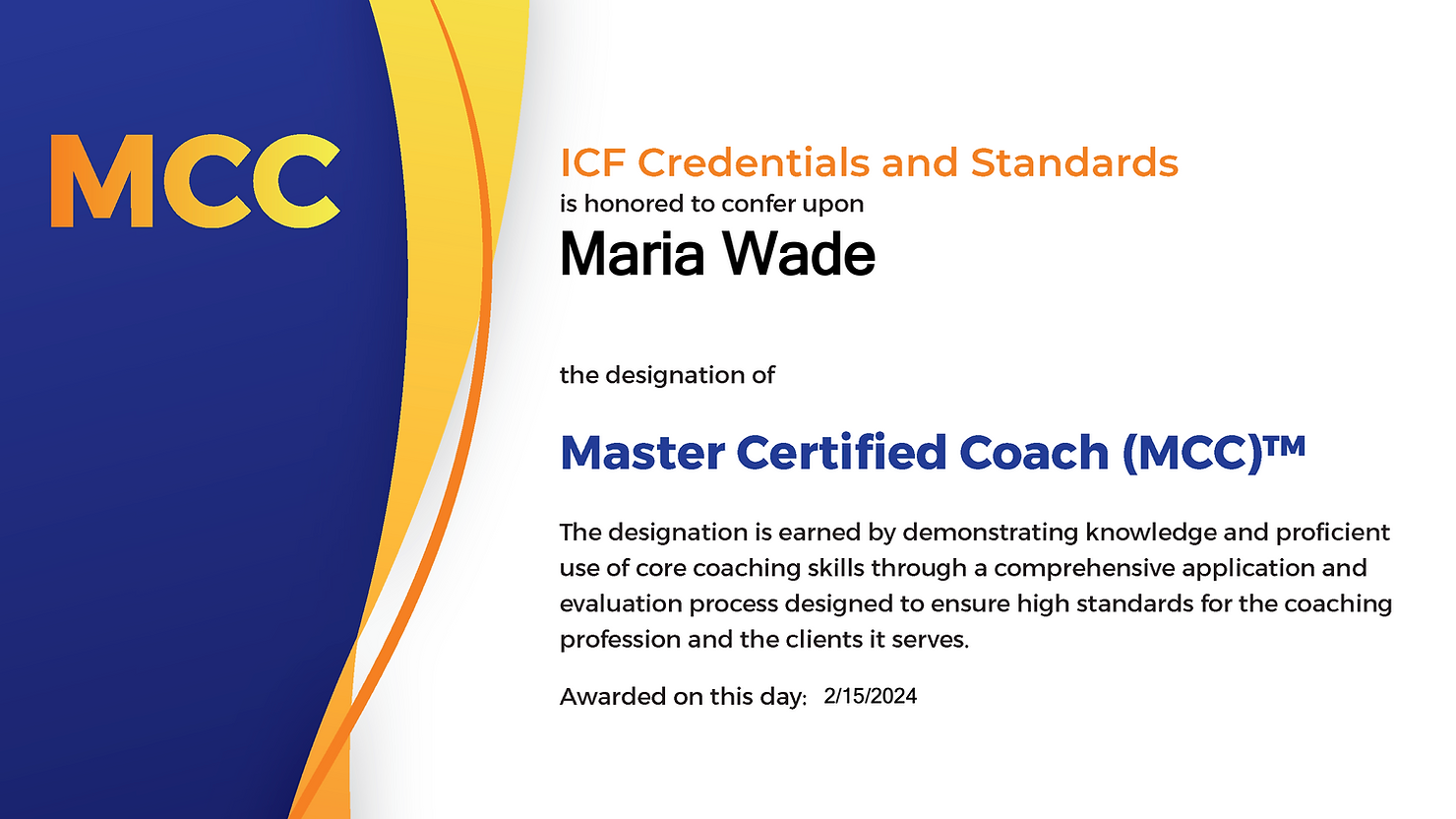
Achieving the Master Certified Coach (MCC) credential from the International Coach Federation was a landmark in this journey. With over 380 hours of education and training under my belt, this wasn’t just a testament to the skills acquired; it was a reflection of the deep, transformative journey I had embarked upon.

But this journey was never just about the destination. It was about the people I met along the way, the mentors who guided me, the clients who entrusted me with their stories, and the colleagues who became companions on this path. It was about the continuous cycle of learning and giving back, of growing as an individual and as a professional.

Now, as I stand on the precipice of new beginnings—writing a book on Executive Presence, leading initiatives as President of the Columbia Coaching Learning Association—I’m reminded of the essence of this journey. It’s about connection, resilience, and the never-ending pursuit of excellence.

Reflecting on the past nine years, I see a tapestry of experiences, challenges, and triumphs. From the boardrooms to the intimate spaces of coaching conversations, it’s been a journey of discovery, not just of my potential but of the profound impact we can have on each other’s lives.

This story, my journey, is a testament to the power of human connection, the beauty of embracing change, and the joy found in pursuing one’s passion. It’s a reminder that sometimes, the most unexpected paths lead us to the most rewarding destinations.

And so, to those who’ve been part of this journey, to the mentors, clients, friends, and family who’ve supported me every step of the way, thank you. Your belief in me has been the greatest gift, fueling my journey and reminding me of the impact we can make when we walk together.

I can only imagine the journey ahead, the stories yet to be written, and the lives we’ll touch. The path from boardrooms to the heart of coaching has been anything but linear, but what a beautiful journey it has been.

Feedback is a powerful tool for growth, yet it is often approached with hesitation and uncertainty. I want to share two conversations that capture the challenge many leaders face:

Coach: What accountability system do you use with your team?

Leader: Honestly, I'm not sure it's an effective one. I hate yelling at people.

And from a different leader, a different conversation:

Coach: What makes feedback challenging for you?

Leader: I don't want to push the person to the breaking point.

Two leaders, two very different fears. One worries about becoming the aggressor. The other worries about causing harm. And yet both arrive at the same place: avoidance. The feedback does not get delivered. The behavior does not get addressed. The team does not grow.

What strikes me about these conversations is how reasonable both leaders sound. They are not avoiding feedback because they lack courage. They are avoiding it because something about the act of giving feedback feels genuinely dangerous to them, either to the relationship or to the other person. And that instinct is worth taking seriously, because the brain has a reason for it.

Why Feedback Feels Like Threat

Research in social neuroscience suggests that social evaluation can recruit neural networks that overlap with those involved in threat and social pain. When feedback feels like judgment, the amygdala registers it as something to defend against, activating stress responses that can impair access to prefrontal capacities like reasoning, emotional regulation, and learning. In practical terms, poorly delivered feedback can make it neurologically harder for the person to absorb what you are saying.

This is not weakness. It is biology. And it explains both of those opening conversations. The first leader’s brain had learned to associate feedback situations with conflict, so the only model he could access was an adversarial one. The second leader’s brain was running a different calculation but from the same threat circuitry: if I say this, I might break something I cannot repair. Neither leader was avoiding accountability because they were soft. They were avoiding it because their nervous systems had no script for feedback that felt safe.

Understanding this changes the question. The question is not whether to give feedback. It is how to deliver it in a way the brain can actually receive.

Enter SBI: A Structure That Works With the Brain

The Situation-Behavior-Impact model, developed by the Center for Creative Leadership, has been a reliable framework for years, and for good reason. It works because it respects how the brain processes information under pressure.

Situation specifies when and where a particular behavior occurred. Behavior describes the observable action. Impact explains how the behavior affected individuals, team dynamics, or broader results.

By grounding feedback in what happened, when it happened, and what it produced, SBI keeps the conversation anchored in observable facts. This matters neurologically: fact-based feedback is less likely to trigger the amygdala’s alarm system, which means the prefrontal cortex stays engaged. The person can actually think about what you are saying rather than defending against how it feels.

But here is what I have learned through hundreds of coaching conversations: SBI, as useful as it is, often stops one step too short.

From SBI to SBII: The Question Than Makes A Difference

After developing the original model, the Center for Creative Leadership extended it with a fourth step: Intent. The model became SBII, Situation-Behavior-Impact-Intent.

After articulating what you observed and its impact, you pause. And you ask:

“Can you help me understand what you were hoping to accomplish?”

Or: “What was your thinking behind that approach?”

Or simply: “I want to make sure I’m not misreading the situation. What was your intent?”

This one addition transforms the interaction from a one-directional assessment into an actual conversation. It signals that you are not just delivering a verdict. You are genuinely curious about what the other person was trying to do. And that curiosity does something remarkable: it shifts the dynamic from correction to collaboration.

Let me illustrate with a coaching dialogue. A leader I worked with was describing a team member, someone I will call Mike:

Leader: Mike's communication has improved significantly during the last few months. However, he can still come off as abrasive, especially when he's convinced he's right.

Coach: Can you recall the most recent occasion when you observed this type of communication?

Leader: It's hard to pinpoint. Perhaps a few months ago...

Coach: Did you share that observation with Mike at the time?

Leader: No, I didn't.

Two problems surfaced here. First, the feedback lacked the specificity that SBI requires. There was no clear situation, no recent observable behavior, no concrete impact. The leader was working from a general impression rather than from data.

But the second problem is more revealing. The moment the leader noticed came and went without a word. Whatever Mike did that registered as abrasive, Mike never heard about it. He had no chance to reflect on it, no chance to course-correct, no chance to explain what he was trying to do. And now, months later, the leader is carrying a stored impression that has hardened into a generalization: Mike can be abrasive when he’s convinced he’s right. That is no longer feedback. It is a conclusion.

Even if the leader were to name a specific moment now, the conversation would likely end with the manager’s assessment of Mike. There would still be no space for Mike’s perspective, no curiosity about what he was trying to accomplish in that moment.

Consider how the same conversation might have gone with the Intent step in place. The leader describes a specific incident, walks through the situation and behavior, names the impact on the team, and then asks: “Mike, when you pushed back so forcefully, what were you hoping the team would understand?”

Now Mike is a participant in his own development, not just a recipient of someone else’s evaluation. And the leader might discover something unexpected: maybe Mike was trying to protect the team from a decision he saw as premature. Maybe his intent was sound even though his delivery created problems. That distinction between intent and impact is where real coaching conversations live.

There is a practical benefit here, too. One criticism of the original SBI model is that it can feel formulaic: I observed this situation, this behavior, this impact. Done. The structure does the work, but the conversation can feel like a checklist rather than a genuine exchange. The Intent inquiry dissolves that problem. It restores mutuality. It turns a message into a dialogue. The person across from you is no longer receiving feedback. They are co-creating an understanding of what happened and what it means.

SBI Is Not Just for Problems

There is a pattern I see repeatedly with senior leaders: the only time they reach for a feedback framework is when something has gone wrong. Corrective feedback gets all the attention. Reinforcing feedback, the recognition of what is working, gets treated as optional.

This is a missed opportunity, and the data is clear on why. A growing body of research suggests that people are significantly more engaged when their manager’s feedback includes specific recognition of strengths. Generic praise does not produce this effect. Telling someone “great job” activates very little. But telling them exactly what they did, when they did it, and what it made possible does.

Reinforcing feedback through SBI sounds like this: “In this morning’s client presentation, you paused to invite the quieter voices to speak before moving to a decision. It shifted the energy in the room. People leaned in rather than checking out, and we left with real alignment rather than polite compliance.”

The specificity is what makes it land. It tells the person not just that they did well, but what specifically to keep doing and why it matters. And for leaders who default to managing by exception, noticing only what breaks, this practice builds the psychological safety that makes corrective feedback possible in the first place.

When people trust that you see what they do well, they can hear what they need to change.

I sometimes ask leaders to keep a simple log for two weeks: every time they give feedback, note whether it was reinforcing or redirecting. Most are startled by the ratio. They thought they were balanced. The log reveals they are almost entirely corrective. That awareness alone, without any new technique, begins to shift how they show up with their teams.

What This Looks Like Through the Leadership Integrity Framework

In my work developing the Leadership Integrity Framework®, I have come to see feedback as a practice that lives at the intersection of all four dimensions: Purpose, Presence, Partnership, and Perspective.

Purpose asks: Who am I as I step into this conversation? This is not about the business rationale for the feedback. It is about the leader’s inner relationship to the act of giving it. Am I giving this feedback because I genuinely care about this person’s development, or because I am frustrated and want to discharge it? Am I speaking from my values, or from my role? What do I believe about this person that makes me willing to say something hard? A leader who has answered these questions for themselves, even quickly, arrives at the conversation differently. The feedback carries their integrity, not just their authority.

Presence asks: How am I showing up as I deliver this? Am I regulated, curious, and grounded, or am I tense, distancing, and performing a role? The neuroscience is relevant here: if the person delivering feedback is dysregulated, the recipient’s brain will pick up on that signal before a single word is spoken. Emotional contagion is real and fast.

Partnership asks: What are we building together? The SBII Intent inquiry is fundamentally a partnership move. It communicates: I am not here to judge. I am here to understand and grow together. This is relational integrity in action, the willingness to be in a conversation rather than to deliver a message.

Perspective asks: What am I not seeing? Leaders who hold this question understand that feedback is not just about individual performance. It is a cultural signal. When feedback is given and received well, it communicates something about the entire organization: safety here is real, learning is expected, and truth is welcomed. When it is given poorly, or avoided altogether, the signal is equally clear: we do not trust each other enough to be honest. That reading of feedback as a system-level indicator, not just an interpersonal technique, is what separates leaders who give good feedback from leaders who build cultures where feedback flows naturally.

From Tool to Practice

The SBI model, and its evolution to SBII, offers a structure that respects both the neuroscience of how humans process evaluation and the relational reality of how trust is built. But a model is only as good as the intention behind it. If feedback remains something you do to someone, no framework will save it. If it becomes something you do with someone, grounded in purpose, delivered with presence, offered in partnership, and held in perspective, it stops being a management obligation and starts being a leadership practice.

I think about both leaders from those opening conversations. Neither was wrong. Accountability can damage relationships when it is delivered as judgment. Feedback can push someone toward a breaking point when it lands on a nervous system that is already overwhelmed. But both leaders were missing the same possibility: that feedback, done well, is one of the most generous things a leader can offer. It says: I see you clearly enough to tell you the truth, and I respect you enough to believe you can do something with it.

The question I leave with you is this: What is one feedback conversation you have been avoiding? And what would change if you approached it with curiosity rather than correction?


I write about leadership, coaching, and the practices that help senior leaders lead with integrity. If these ideas resonate, you are welcome to join the conversation through my newsletter or the MW community WhatsApp channel.

I’ll never forget the day I walked into my first class at Columbia University’s executive coaching program. The room was full of accomplished professionals—people with decades of experience, impressive credentials, and the kind of presence that fills a space before they even speak.

And me? I felt small.

Not because I lacked experience. I’d spent years leading teams, navigating complex organizational dynamics, and coaching leaders through high-stakes transitions. But in that moment, surrounded by people whose expertise seemed so… established, I found myself shrinking. Apologizing for my perspective before I even shared it. Hedging my insights with phrases like “I might be wrong, but…” or “This is just my experience…”

It took a peer pulling me aside after class to name what I couldn’t see: “Maria, you keep apologizing for knowing what you know. Stop it.”

She was right. I wasn’t owning my expertise. I was performing a version of humility that looked like self-awareness but was actually self-doubt wearing a professional mask.

That moment at Columbia was a turning point. It forced me to confront a pattern I now see in many senior leaders I coach: the cost of not owning your expertise.

Many senior leaders quietly struggle with the same question: How do you own your expertise with confidence without losing humility, curiosity, and connection? Balanced leadership is not about choosing between confidence and humility; it is about integrating both so your executive presence is grounded, credible, and deeply human.​

In the Leadership Integrity Framework, this tension sits at the intersection of Purpose (your inner compass), Presence (how you show up), and Partnership (how others experience you). When leaders over‑correct toward humility, they often unintentionally weaken all three.

When Humility Silences Your Expert Voice

There was a season in my own leadership journey when I became deeply inspired by adult development theory, particularly Robert Kegan’s description of the self‑transforming mind—the capacity to hold multiple perspectives and integrate contradictions. Motivated by intellectual humility, I swung my pendulum decisively away from anything that felt like arrogance.​

It worked—until it didn’t. Feedback from that period described me as “indecisive,” “aloof,” and “hard to read.” In my effort to avoid imposing my perspective, I had effectively abandoned my expert voice. Coaching conversations became open‑ended explorations with endless options but very little direction, and my clients felt the cost of that under‑leadership.​

One coaching engagement with a senior leader in financial services brought this into sharp focus. He valued humility, listening, and empowering his team. Yet his people experienced him as hesitant and over‑cautious. His desire not to dominate the conversation resulted in meetings where no one was quite sure what he actually thought. He was admired as a human being, but his leadership was creating confusion and decision paralysis.​

This is the quiet risk of extreme humility in executive roles: when you over‑rotate into deference, your presence starts to disappear.

The Pitfalls of Over‑Corrected Humility

From an executive presence standpoint, humility becomes problematic when it consistently produces:

  • Chronic indecision and delayed calls, even when you have enough information to act
  • Over‑analysis and perfectionism that stall momentum
  • Vague or overly qualified recommendations that confuse stakeholders
  • Teams that feel under‑led, uncertain, or reluctant to move without your explicit direction​

Neuroscience offers one explanation. When leaders constantly scan for others’ opinions and avoid owning their own, they over‑activate monitoring and threat‑detection circuits instead of creative problem‑solving networks. The result is mental fatigue, slower decisions, and a persistent sense of “I should know, but I don’t want to sound too certain.”​

The paradox is this: the very humility that once made you a thoughtful, collaborative leader can, when taken to an extreme, erode trust in your judgment.

Why Owning Your Expertise Matters for Executive Presence

Owning your expertise is not self‑promotion; it is a leadership responsibility. In senior roles, people look to you for:

  • Clear point‑of‑view: “Given everything we’ve heard, what do you recommend?”
  • Grounded confidence under pressure
  • Visible alignment between your words, decisions, and values (your leadership integrity)​

When you claim your expertise with intention:

  • You broadcast credibility. Teams and stakeholders relax when they sense someone is willing to stand behind a thoughtful, well‑grounded perspective.​
  • You strengthen your leadership brand. Over time, people recognize the signature of your judgment and know what kind of decisions to expect from you.​
  • You model mature confidence—confidence that is rooted not in ego, but in experience, discernment, and a willingness to be accountable for your calls.​

This is Presence in the Leadership Integrity Framework: the observable behaviors through which your inner Purpose becomes visible to others. Owning your expertise is one of the most tangible expressions of that presence.

Balanced Leadership: Integrating Humility and Expertise

Balanced leadership is not a 50/50 compromise between humility and confidence. It is the capacity to move fluidly between:

  • Listening and leading: taking in multiple perspectives, then synthesizing them into a clear direction
  • Questioning and deciding: staying genuinely curious until the decision point, then making a call and owning it
  • Learning and guiding: remaining open to being wrong while still offering your expertise as a resource, not a weapon​

In the context of the Leadership Integrity Framework, this balance draws on three dimensions:​

  • Purpose: being clear about your values and philosophy so you know why you hold a particular view.
  • Presence: communicating that view in a way that is confident, calm, and consistent.
  • Partnership: inviting others into the thinking process so they feel respected, not overruled.

From a vertical development perspective, this is a move from either/or thinking (“Either I’m humble or I’m confident”) to both/and capacity (“I can be deeply humble and own my expertise in service of the system”).​

Practical Ways to Own Your Expertise Without Losing Humility

To make this balance real in daily leadership, you can experiment with a few simple practices:

  • Name your stance out loud: After listening to your team, say, “Here’s how I’m currently seeing this, and why,” then invite critique. This signals both clarity and openness.
  • Turn questions into POV plus curiosity: Instead of only asking, “What do you all think?”, add, “My current view is X because Y; what am I missing?”
  • Set decision thresholds: For recurring issues, define in advance what “enough information” looks like so you don’t keep deferring decisions under the banner of humility.
  • Use your expertise as a scaffold, not a script: Offer frameworks, patterns, and risks you see, then ask others to build on them rather than trying to replace them.​

These habits reinforce a form of executive presence that is neither domineering nor diffuse. You remain deeply teachable, but you no longer hide behind questions when what your context needs is a view.

Owning Your Expertise Responsibly

Responsible expertise is always in service of something larger than personal validation. It is anchored in Purpose, expressed through Presence, and experienced through Partnership.​

That means:

  • You use your voice to clarify, not to close down.
  • You share your experience to grow others, not to prove you are right.
  • You remain willing to update your perspective as new information emerges, without apologizing for what you already know.​

If you recognize yourself in this tension—high humility, strong competence, and a nagging sense that you might be under‑using your own expertise—this is often a sign that your next development edge lies in Presence and Partnership, not more technical skill.​

A useful starting question is:
Where am I consistently softening or silencing my expert voice, and what is that costing my team, my organization, and my own integrity as a leader?

Owning your expertise is not a destination; it is an ongoing practice of integration—bringing who you are, what you know, and how you lead into alignment. When you do, your leadership stops feeling like a performance and starts feeling like a coherent expression of your best judgment in service of something that truly matters.

Hello, emerging luminaries and seasoned leaders alike! Today, we’re redefining success in leadership by unveiling an essential element often overlooked in the climb to the top: Your Personal Leadership Brand.

You might assume that crafting a leadership brand is an exercise best suited to the early stages of a career. However, the reality can be quite different. As an emerging leader, you’re often engrossed in scaling the heights of your career ladder, with little time to pause and ponder the significance of your leadership image and the perception you’re building among peers and subordinates. And as you ascend to senior executive or C-suite positions, the need for a well-defined, impactful leadership brand becomes even more pressing.

Your Leadership Brand is not just a catchy phrase or a superficial label. It’s an embodiment of your uniqueness as a leader, the distinctive value you provide, and the promise you make to your audience, whether that’s your team, your organization, or the wider industry. It has the power to transform your leadership trajectory and create a profound impact that resonates far beyond your immediate role.

In this post, I’ll walk you through simple yet powerful exercises designed to help you articulate and shape a leadership brand that truly matters – one that reflects your unique leadership journey and amplifies your influence. It’s a brand that not only communicates who you are as a leader but also the leader you aspire to be.

Finding Your Unique Leadership Value

Embarking on the path to personal brand creation is a journey inward. It’s about understanding who you are as a leader and the unique value you bring to the table. Start with these guiding questions:

  • Who are my key stakeholders and what are their expectations?
  • What unique value do I offer as a leader?
  • What kind of impact do I aspire to make with my leadership?
  • What do I want to be known for?
  • What traits should a leader in my current or desired role exhibit?
  • How do I describe my leadership identity?

Also pose these questions to your stakeholders and welcome their feedback. Their perspectives often reveal aspects of your leadership that you might not see yourself. This journey of self-discovery equips you to create your Leadership Brand Statement:

“I want to be known for being __________ so that I can ________.”

Although simple, this statement is transformative. It guides you towards consistent, authentic leadership that resonates with those around you.

Understanding Your Leadership Brand: Internal and External Perspectives

Your leadership brand has two equally important dimensions: an internal and an external one.

The internal brand is nurtured within your organization and is closely tied to your company’s values and the relationships you nurture within it. It’s expressed through your actions, your decision-making style, problem-solving approach, and the way you inspire and support your team.

The external brand is your image in the broader professional world, including clients, potential employers, or industry peers. It’s about maintaining authenticity while tailoring your image to resonate with different audiences. This often involves online interactions, public speaking, thought leadership articles, or networking events.

Navigating the Challenges

As with any personal and professional endeavor, you’ll face challenges in building your leadership brand. Here are some common ones, along with strategies to overcome them:

  • Inconsistency between perceived and desired brand: There might be a gap between how you perceive your brand and how others do. Regular feedback and self-reflection can help bridge this gap.
  • Difficulty maintaining authenticity: Don’t try to construct a brand that doesn’t align with your true self. Authenticity is crucial in leadership; people trust leaders who are genuine.
  • Resistance to change: You might face resistance, especially if your brand challenges the status quo. Stay resilient, uphold your values, and lead by example.

A Continuous Journey: Your Evolving Leadership Brand

Remember, your leadership brand isn’t static; it evolves with you. Recognizing when and how to adapt your brand is a crucial leadership skill. But how do you identify the need for change? How can you implement these changes effectively?

Embrace the challenges this journey will inevitably bring. You might need to reassess your self-image, take risks, or step outside your comfort zone. But remember, every experience, every stumble, and every victory shapes your evolution as a successful leader.

So, dear leaders, it’s time to redefine your leadership success by crafting your leadership brand. Reflect, interact, learn, grow, and most importantly, enjoy the process (Download a one-page Guide to Building a Personal Leadership Brand).

Your brand is a testament to your unique leadership journey, let it shine authentically!

These questions pave the way for deeper discussions and insights. As a leadership coach, I’m here to facilitate these conversations. Let’s dive into these topics together, explore your unique leadership journey, and work on a brand that truly matters. Contact me for a one-on-one discussion where we can unpack your leadership evolution and build a brand that resonates with your continuous growth.

Leave your comments, ask questions!

Signing off now, wishing you transformative experiences on your journey to a resonant leadership brand.

* this article has been originally published on HRKatha

Many of us have tough conversations almost every single day. They happen at work, at home, with friends and a variety of other stakeholders. We discuss the next promotion, a raise, conflicts, ideas and initiatives at work. We have tough conversations with kids, spouses, partners, siblings and parents. These conversations can push us (and those around us) forward, can improve performance at work and can strengthen bonds. Even through the toughest of conversations, we have a chance to improve our relationships with the people we communicate with.

In reality, however, we prefer not to have these important conversations. We put them off, and in the process, lose an opportunity to solve the issue, seize an opportunity, resolve a conflict, or advance an idea. We put our life on pause, lose days, months, sometimes years, as we tell ourselves, we’ll have that conversation “someday…”

What makes some conversations difficult?

Why do we put off certain conversations? What’s so challenging about them? It has all to do with the uncertainty of outcomes. We have something in our mind that we want to achieve or get from the conversation, but our major fear is that the result will not meet our expectations.

It doesn’t have to be this way. We can leverage other tools at our disposal to make difficult conversations no longer something to be feared, but something to be embraced; just another aspect of moving through the world. To shift this thinking, we need an actionable plan that can help us to get unstuck and overcome the fear of having uneasy conversations through planning and preparation. A tool that exhausts all possible situations and outcomes would be challenging to navigate, so here, I’d like to offer a universal framework that can be easily tailored for each unique situation.

Preparation: What can be your win strategy? What do you do before the conversation?

A few simple questions have helped my clients design a flow to support them through this type of conversation:

How can you reduce stress during this type of conversation, amplify the benefits, and minimize the risks of negative effects?

How can you stop postponing a tough conversation and start acting?

These questions can provide a starting point to guide through the preparation process, which can include the following:

Clarify intent: Get clear on your intent and what you want to accomplish through the conversation. What is the purpose of the conversation? Be honest with yourself, it will help you discover a possible hidden agenda and make sure you understand possible outcomes.

Research your counterpart: What do you know about this person? What kind of personality do they have? What ruffles this person’s feathers? What is their value system? It’s important to understand how to build the conversation, whether to use more data, present the material in a more structured or less formal way, appeal to emotions, or use metaphors and so on.

Plan: Be aware of your own emotional triggers, needs and fears. Create a plan for how you are going to centre yourself if things go out of your control. Be clear on the personal boundaries that you’d like to keep and see respected.

Draw a list: Make up a checklist of topics/ideas/aspects you want to discuss. In a hard conversation, the increased stress may play with your memory. Having a list of key points to cover will help you stay focused and ensure you don’t miss anything important.

Consider the risks: Consider the best-case scenario. It will keep you motivated and engaged. Consider the worst- case scenario. It will help you evaluate risks. Ask yourself whether you can tolerate a possibility of the worst-case scenario. Through this work, you may find out that there is nothing to fear. In some cases, the risk of the worst-case scenario may outweigh the desired outcome, and the best way to act is to hold back the conversation and reconsider your options.

Rehearse. Practice makes perfect. Sometimes, you have very clear thoughts and ideas in your head, but when it is time to speak you cannot articulate them. Having challenging conversations is a skill that can be developed. Choose a person you trust (this can be your coach, friend, or mentor) to rehearse your part of the conversation. Ask them whether your intent is clear, whether your words deliver your message and how they feel at the receiving end.

During the conversation

While begin the conversation, stay positive, keep in mind the desirable outcome, believe in yourself. As Stephen Covey wrote in his book, The 7 Habits of Highly Effective People, first seek to understand then to be understood.

  • Listen carefully as new information intake may help you adjust your strategy, shift your perception, or change your perspective. Listen not to respond, but to understand. Do not interrupt and let go of your immediate reaction. Reflect on what you heard by paraphrasing your partner’s arguments, use key words that your partner uses to make sure that you really understand them.
  • Do not assume, ask. Assumption is a killer of relationships and conversations. Stay centered, keep your integrity. Acknowledge your partner’s point of view, but don’t allow anything to break your boundaries. Brené Brown in her book, Dare to Lead, writes, “leaders need the grounded confidence to stay tethered to their values, respond rather than react emotionally, and operate from self-awareness, not self-protection.”
  • Stay curious and open-minded. Don’t seek to be right, seek to get right.
  • If you’re stuck, brainstorm. Invite your partner to brainstorm to find the best win-win solutions.
  • Breathe. When you breathe deeply, it sends a message to your brain to calm down and relax.
  • Smile. People reflect each other’s emotions. What do you want your partner to reflect?

What if something goes wrong?

Even with all the planning in the world, you cannot script out the conversation’s outcome. Something may not go as planned.

Don’t take a rejection or a verbal attack personally. As one of my teachers taught me: It’s not about you, and they will never stop.

Don’t burn the bridges even if everything is greased for the skids. Give an opportunity to all other parties to calm down, think again, and try to find a win-win solution again, next time.

The good news about difficult conversations is that another one will be right around the corner, offering you an opportunity to continue to hone and develop in this area.

I hope that this step-by-step approach will help you to start an important conversation that you didn’t previously dare to have. Don’t wait for the next time or “someday…” to come (what if it doesn’t?)…carpe diem.

Sources on nurturing relationships and strategies for tough conversations that I have found insightful are as follows:

Brené Brown, Dare to Lead: Brave Work. Tough Conversations. Whole Hearts. (2018)

Mark Goulston, Talking to Crazy (2018)

Nicole Unice, The Miracle Moment: How Tough Conversations Can Actually Transform Your Most Important Relationships (2021)

Stephen Covey, The 7 Habits of Highly Effective People (originally 1989)

P.S. A friend of mine said that it looked like the preparation takes more time than the conversation. Yes, it’s true. Sir Richard Branson, spent nearly 17 years on Virgin Galactic development to achieve his dream and reach space; his flight lasted for just 90 minutes.

Check out one of the earlier posts in my series about toxic positivity here.

I have a mixed relationship with positivity.

Of course, I think it is great to feel joy and happiness, but the truth is, we have an entire range of emotions. And, if we feel we are consistently trying to “look on the bright side” and not let anyone “see us sweat,” we are doing both ourselves and those around us a disservice.

Enter toxic positivity.

As I shared in a prior post on this topic, to live in a state of forced positivity and to white-knuckle ourselves to happiness is counter-productive to our growth, our truth, and our peace.

While many people embrace positivity for the sake of their interactions with others – and wanting to appear in a certain light or not rock the boat – ironically, one of the main areas of collateral damage from toxic positivity is its negative impact on our relationships.

False (+Forced) Positivity in Action

I had a coaching engagement with a client who was working on her relationships. She saw herself as a positive person who always thought positively of other people. She didn’t question them. She acknowledged that she put people on pedestals, as in an art gallery or a museum.

Do these people ever do anything wrong? Respond negatively? Do they ever hurt you? I asked.

She responded that, if they do, she then puts them in a closet.

“I assume they don’t care or want to hurt me; and I don’t want to be around them. If they apologize, they can leave the closet.”

“What are the chances of this?” I inquired.

“Not too big,” she ultimately replied.

If they did overcome and apologize, she let me know she would put them back on the pedestals but would keep her eye on them.

In our work together, we came to a place where we recognized together that her desire for constant positivity had severely impacted her relationships. When everything was positive (even if only on the surface) everything was “fine”; and her relationships could remain. When anything became too real, serious, constructive, or negative, she feared ruining her relationships and would put them away.

Did this help? In the short term, it may have, but ultimately, we realized, she would have a lot of people in closets, unable to connect with them, and everyone else out on pedestals collecting dust.

Deeper, authentic and more genuine relationships with all would open up the possibility for more hurt but would also allow for a new level of connection.

The view from the other side

Through false positivity, we keep people at arm’s length and can be found putting people on a pedestal simply to avoid the truth.

When initially confronted with ongoing positivity, I may react… well, positively… but as our relationship grows, I may feel something is wrong or false. I will come up with a lot of assumptions and might be afraid to ask because I am not sure about our level of trust. I may wonder, are you hiding something from me?

This questioning is simply because we are human, and this is what our brain does when we know something is wrong. We sense a discrepancy, and this initiates a feeling of danger.

If we are putting on a “positive” show and not being truly ourselves, what will people see? What will they feel? How deep will our connection be?

If we know some of these negative impacts, why do we still force our positive attitude?

In most cases, we are afraid of judgment. What we have observed is that if you are “good” and “positive” you receive many compliments and have less problems. We see the behavior that is rewarded; so, it is only natural we try to mimic that which is beneficial.

As we recognize this and work to expand our relationships authentically, there are a few things we can keep in mind.

Tips on how to make relationships deeper, stronger, and more sustainable.

I am very careful when I look at people, but what I remember is they have inner light. I will give them chances to open their heart, to trust me and show this light. This is about creating relationships. If we allow each of us to ignite one light after another, what a beautiful planet it could be.

Showing up as you… real and raw… is actually beneficial and can deepen your relationships. Here are some ways to do this:

● Don’t put people on a pedestal. They are humans and we all can use some compassion.

● Stop assuming. Start asking.

● Share your feelings. Don’t blame. Express your truth.

● Start any conversation by sharing your intent.

● Listen to learn, not to respond.

● Remember about the inner light. Look into their eyes and try to recognize this light. It’s always there.

Are you ready to kick toxic positivity to the curb in your relationships? Are you ready to dig deep and get real?

It can be challenging and vulnerable, but the pay-off will be great.

Practice some of these tips and share with me your results.

Photo by Cornelia Steinwender on Unsplash

“Lack of confidence kills more dreams than lack of ability. You’re capable of more than you think. Don’t be your own bottleneck.”

– James Clear

In senior leadership, confidence is rarely a simple “do I have it or not?” question. More often, it shows up as something subtler: second‑guessing your decisions, over‑editing your contributions in meetings, or worrying that if you speak too strongly, you will be perceived as arrogant. Many executives sit in this tension, wanting to be seen as confident leaders while quietly fearing they might be “too much.”​

In the Leadership Integrity Framework, confidence sits at the intersection of Purpose and Presence: knowing what you stand for and showing up in ways that reflect it. When those two dimensions drift apart, confidence either collapses inward into self‑doubt or inflates outward into something that feels like arrogance.

What Confident Leadership Actually Looks Like

When most people talk about confidence in leadership, they describe a feeling—an inner sense of steadiness or conviction. In practice, leadership confidence looks less like a feeling and more like a set of recognizable behaviors:​

  • Speaking up in difficult conversations and staying in the debate
  • Raising issues with senior stakeholders that others are reluctant to surface
  • Negotiating for what you genuinely believe you or your team deserves
  • Giving full credit to others without feeling diminished by their success

These expressions of confidence share a common thread: a leader who is anchored in their values and willing to stand behind their judgment. That is Presence—your internal clarity made visible through your choices, body language, and communication.

Confidence vs. Arrogance: Why They’re Not the Same

One of the most common concerns leaders bring into coaching is the fear of being perceived as too confident: too direct, too strong, too self‑assured. They have a mental image of the arrogant leader—dismissive, self‑referential, uninterested in feedback—and they want to avoid becoming that person at all costs.​

Here is the surprising truth: confidence and arrogance are not two points on the same line. They are closer to opposite poles.

  • Confidence is grounded in self‑respect and respect for others. It sounds like, “Here is my view, and I’m open to being wrong.”
  • Arrogance is grounded in insecurity and defensiveness. It sounds like, “Here is the view, and disagreement is a threat.”​

Genuine confidence is compatible with humility, curiosity, and learning. Arrogance is what happens when leaders use certainty to shield themselves from vulnerability, feedback, or shared accountability.​

From a Leadership Integrity Framework perspective, confidence is an aligned expression of Purpose and Presence—your inner compass and your outer behavior working together. Arrogance appears when Presence is cut off from Purpose: strong performance signals with little inner reflection or relational awareness.

How Relationship Patterns Shape Your Confidence

Underneath most “confidence issues” is not a personality flaw; it is a relational pattern. How you habitually relate to people directly shapes how confident you feel and how confident you appear.​

When leaders build relationships on:

  • Honesty and openness about what they see
  • Willingness to share opinions and invite others’ views
  • Genuine interest in feedback, even when it stings

…their authenticity does a lot of the confidence work for them. Colleagues experience them as grounded, approachable, and dependable, even when they are still developing in a new role.​

By contrast, when leaders relate from:

  • Conflict avoidance and a strong desire to “look good”
  • Guardedness and reluctance to show where they need support
  • Difficulty giving credit or receiving help

…their lack of transparency becomes their confidence problem. Others experience them as distant or self‑protective, which undermines both trust and executive presence.​

This is where the Partnership dimension of the framework comes in. Confidence is not only an internal state; it is relational. How you connect, listen, and respond to others either amplifies or erodes your felt sense of confidence.​

How to Build Confident Leadership Without Losing Humility

The good news is that leadership confidence is not a fixed trait. It can be developed through intentional, research‑aligned practices that integrate Purpose, Presence, and Partnership.​

You can start with three concrete moves:

  • Deepen your self‑awareness.
    Explore your values, triggers, and habitual stories about your own capability. Notice where “I’m not ready” has become a default narrative rather than a data‑based assessment. Reflect on questions like: When do I actually feel most grounded in my leadership? Where do I reliably under‑estimate myself?​
  • Practice brave vulnerability.
    Identify specific areas where you need support or perspective and name them explicitly. Asking for help does not weaken your authority; it signals maturity, self‑knowledge, and commitment to the work over ego. As Jocko Willink and Leif Babin note, confident leaders elevate others, encourage them to step up, and push praise down the line rather than hoarding it.​
  • Audit how you show up in relationships.
    Watch your micro‑behaviors: Do you celebrate colleagues’ wins without qualification? Do you listen to feedback with genuine openness rather than immediate defense? Are you willing to say, “I got this wrong,” without collapsing into self‑criticism?​

Leaders who work at this integration often describe feeling more quietly assured. Their confidence becomes less about projecting certainty and more about staying consistent with who they are and how they want to lead.

The Heart of Confident Leadership

If you want to build sustainable, authentic confidence, start with how you relate to yourself and to others.​

  • Purpose clarifies what you stand for.
  • Presence communicates that clarity in a way others can feel.
  • Partnership ensures your confidence strengthens relationships rather than constricting them.​

In the end, nothing signals real confidence more than an open mind and an open heart.

Photo by Amandine Lerbscher on Unsplash